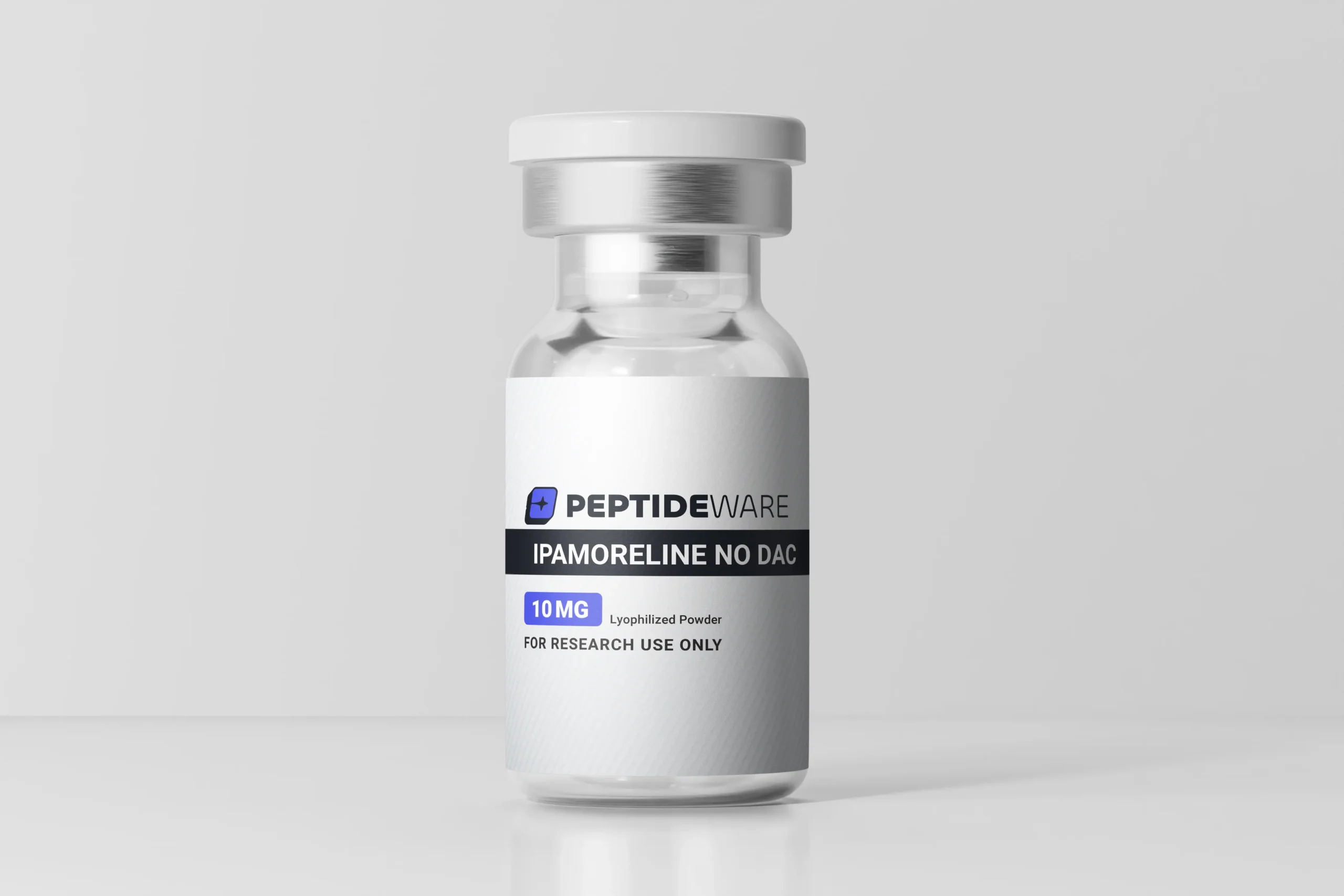


Description
Mechanism: Selective GHS-R1a Agonism
Ipamorelin functions as a potent agonist of the Ghrelin Receptor (GHS-R1a) located in the anterior pituitary gland. By binding to these receptors, it triggers a signaling cascade that stimulates the release of endogenous Growth Hormone (GH).
The “Selectivity” Advantage: The primary research value of Ipamorelin lies in its selectivity profile compared to first-generation GHRPs like GHRP-6 or GHRP-2.
-
Targeted Release: Ipamorelin induces GH release with efficacy comparable to GHRP-6.
-
Side Effect Profile: Uniquely, it does so without significantly stimulating the release of ACTH (cortisol), prolactin, or acetylcholine.
-
Hunger Modulation: While it mimics ghrelin mechanisms, Ipamorelin displays significantly less influence on orexigenic (appetite) signaling compared to GHRP-6, making it an ideal candidate for studies where feeding behavior must remain a controlled variable.
This research peptide undergoes rigorous quality control and stability testing to ensure maximum integrity for scientific applications. Each batch is manufactured under strict laboratory conditions and verified through independent laboratory analysis.
⚠️ FOR RESEARCH PURPOSES ONLY
This product is strictly for in-vitro laboratory research, analysis, and development. It is not intended for human consumption, injection, or therapeutic use. Ipamorelin is not a drug, dietary supplement, or food. All statements regarding the physiological mechanisms of Ipamorelin are based on preclinical animal and cell-culture studies and are provided for educational and informational purposes only.
Research Synergy: The Dual-Signaling Pathway
Ipamorelin is most frequently researched in combination with CJC-1295 No DAC (Mod GRF 1-29). This pairing is investigated for its ability to target the somatotropic axis from two distinct angles:
-
Ipamorelin: Acts as the “pulse generator” by neutralizing somatostatin (the inhibitor) and initiating the GH pulse.
-
CJC-1295: Acts as the “amplifier” (GHRH analog) to increase the volume of the pulse.
-
Outcome: This “Dual-Signaling” approach is hypothesized to result in a maximal GH amplitude that exceeds the sum of the peptides administered individually.
Technical Specifications
-
Sequence: Aib-His-D-2-Nal-D-Phe-Lys-NH2
-
CAS Number: 170851-70-4
-
Molecular Formula: C₃₈H₄₉N₉O₅
-
Molar Mass: 711.85 g/mol
-
Purity: ≥99% (HPLC Verified)
-
Form: Lyophilized White Powder