

Description
What Is Ipamorelin?
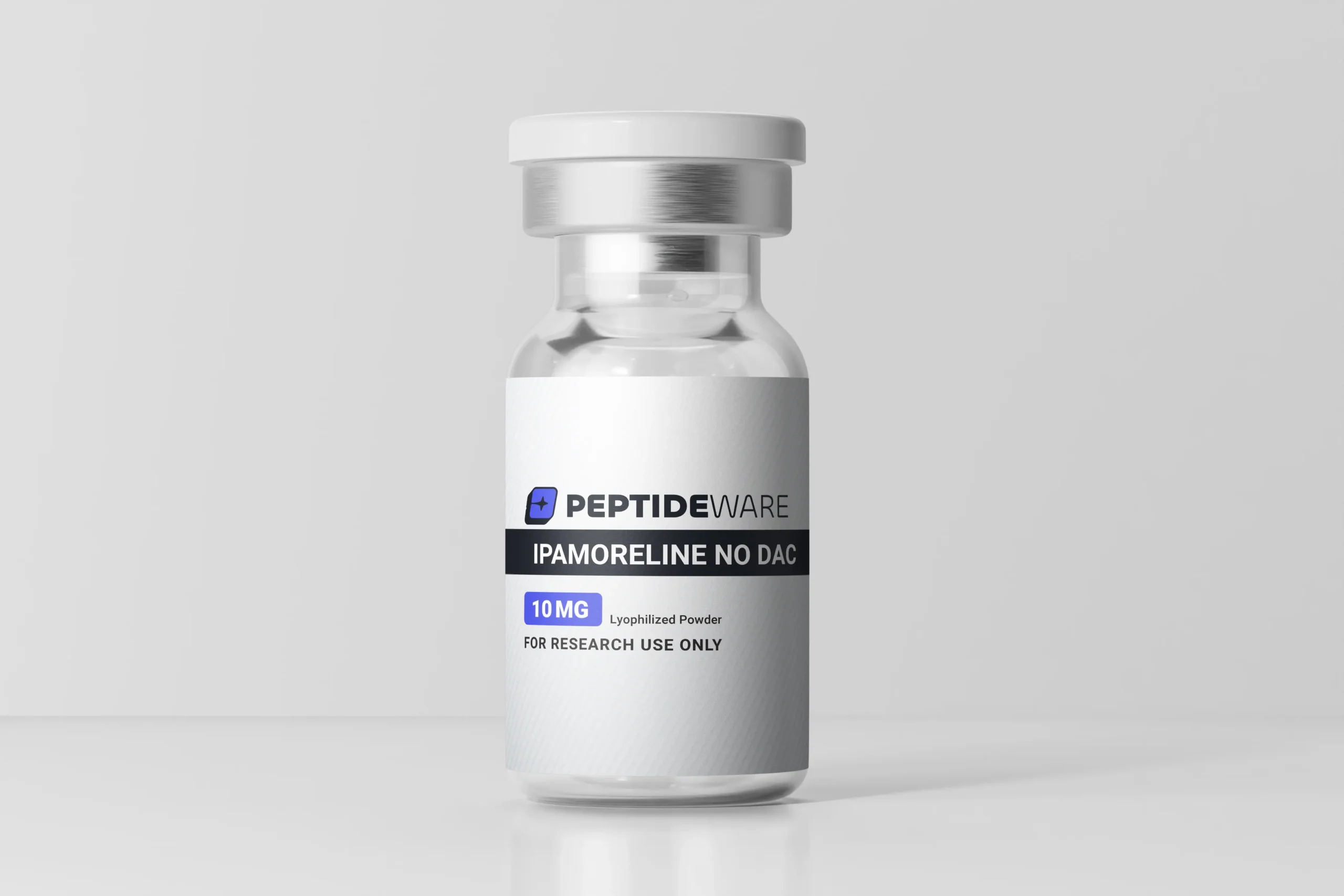
Ipamorelin is a third-generation synthetic pentapeptide growth hormone secretagogue that selectively binds the ghrelin receptor (GHS-R1a). Distinguished by high specificity, it stimulates GH release without significantly affecting cortisol, ACTH, or prolactin levels. HPLC-verified at 99%+ purity with publicly available COA.
Why Researchers Choose Ipamorelin
- Third-generation selective ghrelin receptor (GHS-R1a) agonist — the “cleanest” GH secretagogue available for precise neuroendocrine research protocols
- Clean hormonal profile: preclinical research indicates Ipamorelin does not significantly elevate cortisol, prolactin, or aldosterone
- Verified purity: ≥99% confirmed via independent HPLC and mass spectrometry (C₃₈H₄₉N₉O₅, MW: 711.85 Da)
- Synergistic “amplifier effect”: published studies suggest enhanced GH output when combined with CJC-1295 in research protocols
- Selective pentapeptide design: enables controlled, reproducible neuroendocrine research with minimal confounding variables
Frequently Asked Questions
What is Ipamorelin?
Ipamorelin is a third-generation synthetic pentapeptide classified as a growth hormone secretagogue with high specificity for the ghrelin receptor (GHS-R1a). It is investigated in preclinical research for its ability to stimulate GH release without significantly elevating cortisol or prolactin. This product is for laboratory research use only.
How do I reconstitute Ipamorelin?
Add 2 mL of bacteriostatic water to the 10 mg lyophilized vial for a concentration of 5 mg/mL. Roll the vial gently between your palms — do not shake. See our Reconstitution 101 guide for full step-by-step instructions.
What purity verification is provided?
Every batch of Ipamorelin is verified at ≥99% purity via high-performance liquid chromatography (HPLC) and mass spectrometry confirming molecular weight at 711.85 Da. A Certificate of Analysis (COA) is available for each lot.
How should I store Ipamorelin?
Lyophilized (powder): Store at -20°C for long-term storage or 2–8°C for short-term use. Reconstituted: Store at 2–8°C and use within 28 days. Protect from light and avoid repeated freeze-thaw cycles.
How does Ipamorelin differ from CJC-1295?
Ipamorelin targets the ghrelin receptor (GHS-R1a) and belongs to the GHRP class of secretagogues, while CJC-1295 targets the GHRH receptor as a growth hormone releasing hormone analog. These are distinct mechanisms of action — published research suggests a synergistic “amplifier” effect when both receptor pathways are activated simultaneously in research models.
What published research exists on Ipamorelin?
Ipamorelin is indexed on PubMed with preclinical research covering selective GH secretion, neuroendocrine signaling pathways, and body composition modeling in animal studies. All available research is preclinical in nature.
Can Ipamorelin be combined with other peptides in research?
Yes. Ipamorelin is frequently studied alongside CJC-1295 (both DAC and No DAC variants) in published research protocols. The combination targets two distinct receptor pathways — GHRP and GHRH — for amplified GH release in preclinical models.
Further Reading
- Peptide Reconstitution 101 — Step-by-step guide to preparing lyophilized peptides for research
Mechanism: Selective GHS-R1a Agonism
Ipamorelin functions as a potent agonist of the Ghrelin Receptor (GHS-R1a) located in the anterior pituitary gland. By binding to these receptors, it triggers a signaling cascade that stimulates the release of endogenous Growth Hormone (GH).
The “Selectivity” Advantage: The primary research value of Ipamorelin lies in its selectivity profile compared to first-generation GHRPs like GHRP-6 or GHRP-2.
-
Targeted Release: Ipamorelin induces GH release with efficacy comparable to GHRP-6.
-
Side Effect Profile: Uniquely, it does so without significantly stimulating the release of ACTH (cortisol), prolactin, or acetylcholine.
-
Hunger Modulation: While it mimics ghrelin mechanisms, Ipamorelin displays significantly less influence on orexigenic (appetite) signaling compared to GHRP-6, making it an ideal candidate for studies where feeding behavior must remain a controlled variable.
This research peptide undergoes rigorous quality control and stability testing to ensure maximum integrity for scientific applications. Each batch is manufactured under strict laboratory conditions and verified through independent laboratory analysis.
⚠️ FOR RESEARCH PURPOSES ONLYThis product is strictly for in-vitro laboratory research, analysis, and development. It is not intended for human consumption, injection, or therapeutic use. Ipamorelin is not a drug, dietary supplement, or food. All statements regarding the physiological mechanisms of Ipamorelin are based on preclinical animal and cell-culture studies and are provided for educational and informational purposes only.
Research Synergy: The Dual-Signaling Pathway
Ipamorelin is most frequently researched in combination with CJC-1295 No DAC (Mod GRF 1-29). This pairing is investigated for its ability to target the somatotropic axis from two distinct angles:
-
Ipamorelin: Acts as the “pulse generator” by neutralizing somatostatin (the inhibitor) and initiating the GH pulse.
-
CJC-1295: Acts as the “amplifier” (GHRH analog) to increase the volume of the pulse.
-
Outcome: This “Dual-Signaling” approach is hypothesized to result in a maximal GH amplitude that exceeds the sum of the peptides administered individually.
Technical Specifications
-
Sequence: Aib-His-D-2-Nal-D-Phe-Lys-NH2
-
CAS Number: 170851-70-4
-
Molecular Formula: C₃₈H₄₉N₉O₅
-
Molar Mass: 711.85 g/mol
-
Purity: ≥99% (HPLC Verified)
-
Form: Lyophilized White Powder