

Description
What Is SLU-PP-332?
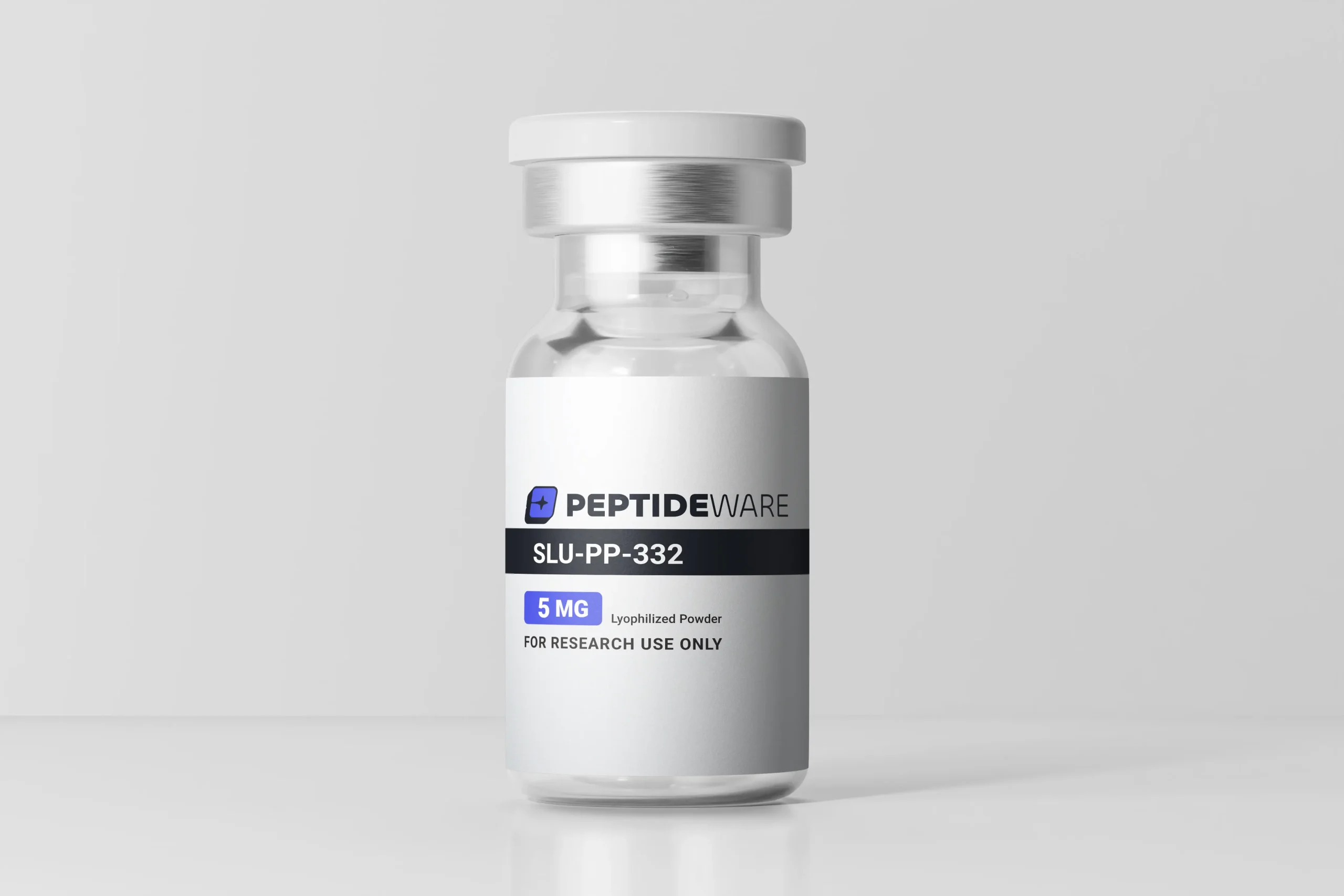
SLU-PP-332 is a synthetic small molecule agonist of the Estrogen-Related Receptors (ERRs), often called exercise in a bottle. It activates metabolic pathways mimicking endurance exercise adaptations without physical exertion. Research focuses on mitochondrial biogenesis, fatty acid oxidation, and exercise mimetic effects. HPLC-verified at 99%+ purity with publicly available COA.
Why Researchers Choose SLU-PP-332
- Novel ERR Agonist — “Exercise in a Bottle” Research Compound — SLU-PP-332 is a selective agonist of Estrogen-Related Receptors (ERRα/ERRγ), studied for its ability to replicate transcriptional programs activated by endurance exercise.
- Directly Modulates Mitochondrial Biogenesis Transcription — Published studies suggest SLU-PP-332 activates ERR-dependent gene transcription to drive mitochondrial biogenesis and oxidative metabolism at the genomic level.
- Muscle Fiber Type Switching Research — Preclinical research indicates this compound promotes a phenotypic shift toward Type I (oxidative/slow-twitch) muscle fibers, which are rich in mitochondria and resistant to fatigue.
- Verified Purity: ≥99% (HPLC) — Every batch undergoes independent third-party laboratory verification for maximum research integrity.
- 5 mg Format for Metabolic Research — Research-grade quantity for protocols investigating ERR pathway modulation, fatty acid oxidation, and exercise-mimetic transcriptional programs.
Frequently Asked Questions
What is SLU-PP-332?
SLU-PP-332 is a synthetic small-molecule agonist of the Estrogen-Related Receptor (ERR) family, developed at Saint Louis University. Despite the name, ERRs do not bind estrogen and are not part of the classical estrogen signaling pathway. Instead, ERRs are orphan nuclear receptors that regulate mitochondrial biogenesis, fatty acid oxidation, and oxidative phosphorylation — the same transcriptional programs activated by endurance exercise. Published studies suggest SLU-PP-332 is among the most selective ERR agonists available for research.
How do I reconstitute SLU-PP-332 for laboratory use?
SLU-PP-332 is soluble in DMSO. Dissolve the 5 mg lyophilized powder in an appropriate volume of DMSO to achieve the desired stock concentration for your research protocol. For aqueous working solutions, further dilute the DMSO stock into an appropriate buffer. Consult published protocols for specific solvent compatibility in your experimental system.
What purity standard does this product meet?
Every batch is verified at ≥99% purity via high-performance liquid chromatography (HPLC) through independent third-party laboratory analysis.
How should SLU-PP-332 be stored?
Store the lyophilized powder at -20°C or below for long-term stability (up to 24 months). Once reconstituted in DMSO, store aliquots at -20°C and minimize freeze-thaw cycles. Protect from light and moisture.
How does SLU-PP-332 differ from traditional metabolic agents?
Most metabolic compounds work through receptor agonism at the cell surface (e.g., GLP-1 receptor agonists) or enzyme inhibition. SLU-PP-332 operates at the transcriptional level — it activates nuclear receptors (ERRs) that directly control the expression of genes governing mitochondrial biogenesis, fatty acid oxidation, and oxidative phosphorylation. This genomic mechanism mirrors the transcriptional adaptations produced by endurance exercise training.
What does published research say about SLU-PP-332?
Preclinical research indicates SLU-PP-332 activates ERRα and ERRγ to drive mitochondrial biogenesis gene expression, promotes a shift toward oxidative (Type I) muscle fiber phenotypes, enhances fatty acid oxidation, and increases exercise endurance capacity in animal models. Published studies suggest these effects occur through transcriptional modulation rather than direct metabolic substrate manipulation.
Can SLU-PP-332 be used in combination research protocols?
Researchers studying exercise-mimetic pathways and metabolic regulation may design protocols incorporating SLU-PP-332 alongside complementary compounds targeting AMPK activation (MOTS-c), mitochondrial membrane stabilization (SS-31), or NAD+-dependent enzymatic pathways. Always consult peer-reviewed literature when designing multi-compound research protocols.
Further Reading
New to peptide research? Visit our Peptide Reconstitution 101 guide for step-by-step instructions on proper handling, storage, and reconstitution techniques.
Mechanism: Estrogen-Related Receptor (ERR) Agonism
SLU-PP-332 is distinguished by its high selectivity for ERR$alpha$ and ERR$gamma$ (Estrogen-Related Receptor Alpha and Gamma). Importantly, it does not bind to the classical Estrogen Receptor (ER), avoiding hormonal side effects.
-
Mitochondrial Biogenesis: By activating ERR, SLU-PP-332 drives the transcription of genes involved in the Electron Transport Chain (ETC) and the Krebs cycle.
-
Fiber Type Switching: Research demonstrates that administration can induce a phenotypic shift in skeletal muscle, increasing the proportion of Type I (Oxidative/Slow-Twitch) fibers. These fibers are dense in mitochondria and resistant to fatigue.
-
Fatty Acid Oxidation: The compound promotes the utilization of fatty acids as a primary fuel source, effectively increasing whole-body energy expenditure without altering caloric intake or appetite.
This research peptide undergoes rigorous quality control and stability testing to ensure maximum integrity for scientific applications. Each batch is manufactured under strict laboratory conditions and verified through independent laboratory analysis.
⚠️ FOR RESEARCH PURPOSES ONLY
This product is strictly for in-vitro laboratory research, analysis, and development. It is not intended for human consumption, injection, or therapeutic use. SLU-PP-332 is not a drug.
Technical Specifications
-
Chemical Class: Synthetic ERR Agonist (Benzimidazole Derivative)
-
Target: Estrogen-Related Receptor (ERR$alpha$ / ERR$gamma$)
-
Formula: {24}H_{26}N_{2}O_{4}$
-
Molar Mass: ~406.5 g/mol
-
Purity: ≥99% (HPLC Verified)
-
Form: Lyophilized White Powder
-
Solubility: Soluble in DMSO; requires careful reconstitution protocols for aqueous solutions.
Storage & Handling
Peptides require careful storage to maintain their integrity and research effectiveness. Lyophilized peptides should be stored in a cold, dry, dark environment to prevent degradation. For short-term use within 4 weeks, storage at 4°C is sufficient, while long-term storage requires temperatures below -20°C or -80°C for extended periods up to 2 years. Always protect peptides from light exposure and avoid repeated freeze-thaw cycles, which can compromise structural integrity and research results.