


Last Updated: March 2026 | v1.0
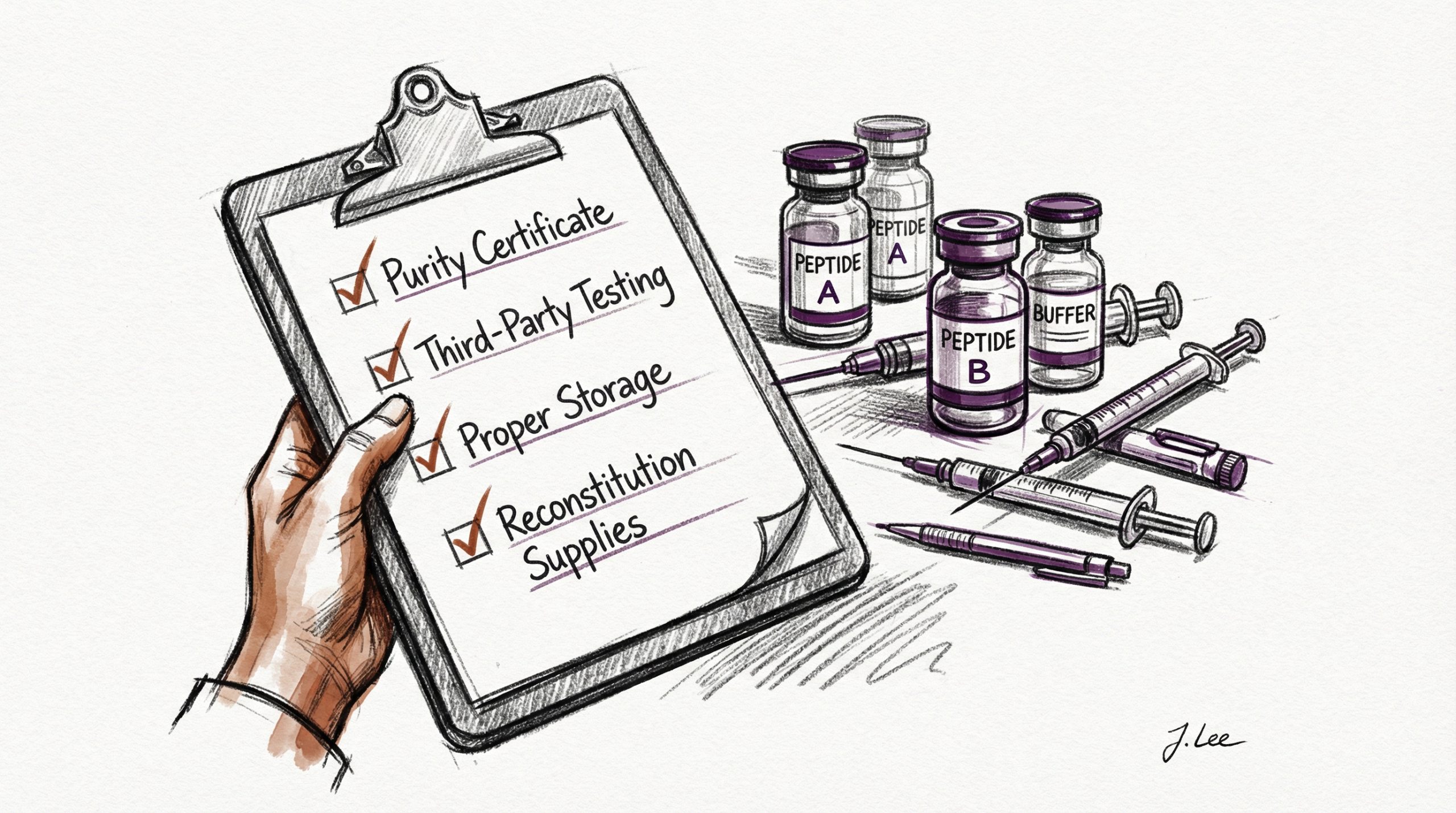
Purchasing research peptides requires evaluating multiple quality, documentation, and logistics factors that are not always obvious — especially for researchers new to peptide procurement. The market includes hundreds of suppliers with varying levels of quality control, testing transparency, and operational reliability. Some suppliers provide independently verified compounds with published COAs; others sell untested products with unverifiable claims. The difference between these extremes directly impacts research reproducibility, data accuracy, and the overall value of your procurement budget. This checklist consolidates the critical evaluation criteria into a practical, actionable format that researchers can use before placing any peptide order. All products and information are provided for laboratory and research purposes only.
Quick Reference: The 10-Point Checklist
- Third-party purity testing (HPLC)
- Mass spectrometry identity confirmation
- Batch-specific COAs published before purchase
- Purity threshold ≥98%
- Domestic shipping with proper handling
- Transparent business information
- Consistent product availability
- Proper packaging and labeling
- Reconstitution resources and support
- No misleading health or medical claims
Free reconstitution calculator for dosage preparation, peptide reference library for protocol data, and research guides — all free, no account required.
1. Does the Supplier Provide Third-Party Purity Testing?
This is the single most important criterion. Third-party testing means the purity analysis is performed by an independent laboratory with no financial relationship to the supplier. Look for the testing laboratory’s name on the COA — if only the supplier’s name appears, the testing may be in-house, which creates a conflict of interest. Self-tested results are a starting point, but independent verification is the standard for research-grade procurement. Peptideware uses independent third-party laboratories for every batch — see our third-party testing explanation for details on the process.
2. Is Mass Spectrometry Data Included?
HPLC measures how pure a sample is, but mass spectrometry (MS) confirms what the sample actually is. A COA with HPLC data only tells you the sample is 98% of something — MS confirms that “something” is the correct peptide. Look for the observed molecular weight, the expected molecular weight, and the deviation (should be <2 Da). COAs lacking MS data leave peptide identity unconfirmed. For more on the difference between HPLC and MS, see our peptide purity guide.
3. Are COAs Batch-Specific and Available Before Purchase?
A credible COA must reference a specific batch or lot number. Generic COAs without batch numbers may not correspond to the product you receive. Additionally, the COA should be accessible before you place an order — not provided only after purchase or upon special request. Pre-purchase access allows researchers to evaluate quality documentation as part of the procurement decision. Suppliers who withhold COAs until after purchase create an information asymmetry that disadvantages the researcher.
4. Does the Purity Meet Research-Grade Thresholds?
Research-grade peptides are generally defined as ≥98% purity by HPLC analysis. Peptides below 95% purity introduce impurity levels that can meaningfully confound experimental results — truncated sequences may have partial activity, oxidized variants can trigger unrelated biological pathways, and inaccurate effective concentrations undermine dose-response calculations. Verify that the stated purity on the COA is supported by the chromatogram — a single dominant peak with a clean baseline should visually correspond to the reported percentage.
5. Does the Supplier Offer Domestic Shipping with Proper Handling?
Peptide stability during transit matters. Lyophilized peptides are generally stable at ambient temperatures for short shipping durations, but extended exposure to high temperatures (above 30 °C / 86 °F) can accelerate degradation. Domestic suppliers with warehouse operations within your country reduce transit times and eliminate customs delays, import documentation requirements, and the unpredictable handling conditions of international shipping. Peptideware ships same-day from Ohio, with packaging designed to protect peptide integrity during transit. For temperature-sensitive orders during summer months, insulated packaging or cold packs should be standard.
6. Is the Business Information Transparent?
Legitimate suppliers provide clear business information: a verifiable physical address, contact phone number or email, and responsive customer service. Be cautious of suppliers operating through anonymous websites, using only generic email addresses (e.g., Gmail or Yahoo), or listing no physical address. These patterns may indicate dropshipping operations with no quality oversight or direct product handling. Peptideware operates from Ohio with identifiable business operations and direct customer support.
7. Does the Supplier Maintain Consistent Product Availability?
Frequent stockouts, long backorder periods, or discontinuation of popular products may indicate supply chain instability. Reliable suppliers maintain consistent inventory of their core catalog items. Chronic availability issues can disrupt ongoing research protocols, forcing researchers to switch suppliers mid-study and introducing uncontrolled variables. Before committing to a supplier for a multi-week research protocol, verify that your required products are consistently in stock.
8. Is the Product Properly Packaged and Labeled?
Research peptides should arrive in sealed, labeled vials with the peptide name, quantity (in mg), batch/lot number, and storage instructions clearly indicated. Vials should be sealed with crimped aluminum caps over rubber stoppers — not screw caps, which may not maintain sterility. The packaging should protect against physical damage during shipping. Absence of clear labeling makes it impossible to verify that the received product matches the ordered product and complicates inventory management in multi-compound research protocols.
9. Does the Supplier Provide Reconstitution Resources?
Quality suppliers provide educational resources that support proper peptide handling and preparation. This includes reconstitution instructions, storage guidelines, and dosage calculation tools. These resources indicate that the supplier understands its researchers’ needs and invests in supporting proper compound use. Peptideware maintains a reconstitution guide and partners with HowToMixPeptides.com, which offers a free reconstitution calculator, peptide guides, and protocol references — all accessible without an account or purchase.
10. Does the Supplier Avoid Misleading Health Claims?
Reputable research peptide suppliers clearly label their products for laboratory and research use only. Suppliers making medical claims, referencing human dosing protocols, or marketing peptides as treatments for specific conditions are operating outside appropriate regulatory boundaries. This behavior may indicate willingness to cut other corners as well. Look for clear research-use disclaimers and compliance-appropriate language throughout the supplier’s website and product descriptions. The presence of FDA disclaimers and consistent “for research purposes only” labeling indicates a supplier that understands and respects the regulatory framework governing research compounds.
Red Flags to Watch For
Several warning signs should prompt additional scrutiny or avoidance:
- No COAs available — or COAs only provided after purchase
- HPLC data only — no mass spectrometry identity confirmation
- Generic COAs — no batch numbers or dates
- Unrealistically low prices — prices significantly below market average may indicate lower purity, smaller quantities, or compromised quality control
- Medical claims — marketing peptides for specific health conditions or providing human dosing instructions
- No physical address — anonymous or unverifiable business operations
- Payment only via cryptocurrency — while not inherently problematic, crypto-only payment combined with other red flags may indicate an operation designed to avoid accountability
Frequently Asked Questions
What is the most important factor when choosing a peptide supplier?
Third-party purity testing with both HPLC and mass spectrometry verification. This provides objective confirmation of both purity and identity from an independent source with no financial incentive to report favorable results.
Is it safe to buy peptides from overseas suppliers?
Overseas suppliers can provide quality products, but verification is more difficult. Customs delays, import restrictions, and the inability to verify COAs add risk. Domestic suppliers with transparent operations reduce these uncertainties.
How do I know if a COA is legitimate?
Legitimate COAs include a batch number, chromatogram image, MS spectrum, testing lab identification, and analysis date. If any of these elements are missing, the COA’s credibility is reduced. The testing lab should be independently verifiable.
What purity level should I look for?
Research-grade peptides should be ≥98% purity by HPLC. Below 95%, impurity levels can meaningfully affect experimental results. Verify that the chromatogram visually supports the stated percentage — a clean, dominant single peak.
Should I use the same supplier throughout a study?
Ideally, yes. Using the same supplier (and same batch when possible) throughout a study eliminates supplier-related variability as a confounding factor. If switching suppliers mid-study is unavoidable, document the change in your methods.
Where can I find a supplier that meets all these criteria?
Peptideware meets all ten checklist criteria: independent third-party HPLC and MS testing, batch-specific COAs published on every product page, ≥98% purity threshold, same-day domestic shipping from Ohio, transparent business operations, and research-appropriate labeling throughout.
For research purposes only. All products and information are provided for laboratory and research purposes only.


