


Last Updated: March 2026 | v1.0
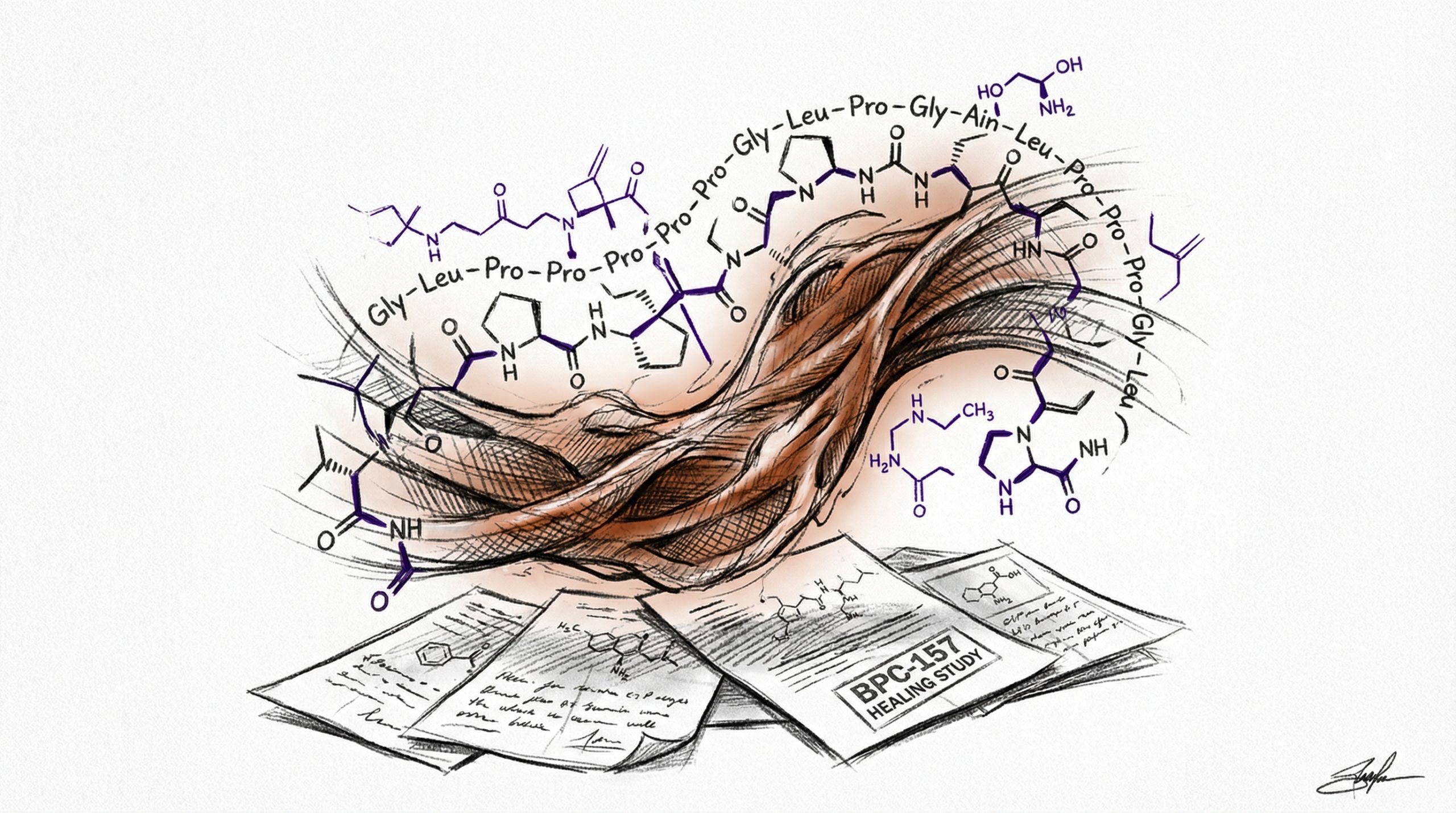
BPC-157 (Body Protection Compound-157) is a synthetic 15-amino-acid peptide derived from a protective protein found in human gastric juice. It is one of the most extensively studied peptides in preclinical research, with over 100 published studies examining its effects on tissue repair, angiogenesis, nitric oxide signaling, and inflammatory modulation in animal models. BPC-157 has a molecular weight of 1,419.53 Da and the sequence Gly-Glu-Pro-Pro-Pro-Gly-Lys-Pro-Ala-Asp-Asp-Ala-Gly-Leu-Val. Unlike many bioactive peptides, BPC-157 demonstrates stability in gastric acid — a property that distinguishes it from growth factors and cytokines that degrade rapidly in acidic environments. Researchers investigating wound healing, tendon repair, gut integrity, and neuroprotection frequently use BPC-157 as a reference compound in preclinical protocols. This guide consolidates the published research, explains the proposed mechanism of action, and provides standard laboratory reconstitution and dosage protocols. All products and information are provided for laboratory and research purposes only.
Quick Facts: BPC-157
- Classification: Synthetic pentadecapeptide (15 amino acids) derived from human gastric juice protein
- Molecular weight: 1,419.53 Da
- Published studies: 100+ preclinical studies indexed on PubMed
- Primary research areas: Tissue repair, tendon healing, gut integrity, neuroprotection, angiogenesis
- Gastric stability: Remains active in acidic environments (pH 2-3), unlike most bioactive peptides
Use the free reconstitution calculator for exact syringe units, or browse the BPC-157 reference page for dosing and protocol data.
What Is the Mechanism of Action of BPC-157?
BPC-157’s mechanism of action involves multiple interconnected signaling pathways, which is why it appears in such a broad range of preclinical research contexts. The most well-documented mechanism is the upregulation of vascular endothelial growth factor (VEGF), which promotes angiogenesis — the formation of new blood vessels from existing vasculature. Published studies suggest that BPC-157 increases VEGF receptor expression (VEGFR2) in endothelial cells, accelerating blood vessel formation at injury sites (PubMed: 24186207). Increased vascularization delivers more oxygen, nutrients, and immune cells to damaged tissue, which is the foundational requirement for tissue repair in any organ system.
The second major pathway involves the nitric oxide (NO) system. Preclinical research indicates that BPC-157 modulates nitric oxide synthase (NOS) activity, which regulates vasodilation, blood flow, and inflammatory signaling. In animal models of gastric ulcers, BPC-157 administration was associated with normalized NO production and accelerated mucosal healing (PubMed: 29898181). The NO pathway also connects to BPC-157’s observed effects on blood pressure regulation and vascular tone in preclinical models.
A third proposed mechanism involves the growth hormone (GH) receptor system. Some studies suggest BPC-157 may interact with GH receptors to enhance tissue regeneration, though this pathway is less thoroughly characterized than the VEGF and NO pathways. BPC-157 has also been observed to modulate dopaminergic and serotonergic signaling in rodent models, which connects to the neuroprotective research discussed below (PubMed: 27142720).
What Does the Published Research Show for Tissue Repair?
Tissue repair is the most extensively studied application of BPC-157 in preclinical models. A 2010 study in the Journal of Orthopaedic Research examined BPC-157’s effects on transected rat Achilles tendons and found that BPC-157-treated subjects showed significantly faster functional recovery compared to controls, with biomechanical testing demonstrating increased tendon load-to-failure at 14 days post-injury (PubMed: 20014201). The researchers attributed the accelerated healing to increased fibroblast proliferation and organized collagen deposition at the injury site.
A separate study examined BPC-157 in a rat model of medial collateral ligament (MCL) injury. Animals receiving BPC-157 demonstrated earlier return of biomechanical strength and more organized collagen fiber alignment compared to saline-treated controls (PubMed: 21030672). These findings were consistent across multiple tendon and ligament injury models, establishing BPC-157 as one of the most studied peptides in musculoskeletal repair research.
Muscle repair studies have also shown positive outcomes. In crushed muscle injury models, BPC-157 administration was associated with faster restoration of muscle function, reduced inflammatory infiltrate, and enhanced satellite cell activation — the progenitor cells responsible for muscle regeneration (PubMed: 20225319). Researchers investigating skeletal muscle injuries frequently reference these findings when designing protocols involving tissue-protective compounds.
What Are the Gastrointestinal Research Findings?
BPC-157 was originally isolated from gastric juice proteins, and gastrointestinal research represents its deepest body of published literature. Multiple studies have demonstrated cytoprotective effects in animal models of gastric ulcers induced by ethanol, NSAIDs, and stress. In a comprehensive review, Sikiric et al. documented that BPC-157 accelerated gastric mucosal healing, reduced lesion size, and maintained mucosal integrity under conditions that normally produce significant tissue damage (PubMed: 25415894).
Beyond the stomach, BPC-157 has been studied in models of inflammatory bowel conditions. In a rat model of colitis, BPC-157 reduced inflammatory markers, decreased mucosal damage scores, and promoted epithelial regeneration compared to untreated controls (PubMed: 18384897). The peptide also demonstrated protective effects against intestinal anastomosis failure — a model relevant to post-surgical gut healing research. These gastrointestinal findings are notable because BPC-157 demonstrated efficacy via both systemic (parenteral) and local (oral) administration in published protocols, a flexibility not commonly observed with bioactive peptides.
What Has Been Studied Regarding Neuroprotection?
A growing body of preclinical literature examines BPC-157’s effects on the central and peripheral nervous systems. In rodent models, BPC-157 has been studied for its interactions with dopaminergic pathways. Sikiric et al. reported that BPC-157 counteracted behavioral and neurochemical changes induced by dopaminergic system disruption, suggesting a modulatory effect on dopamine turnover (PubMed: 27142720). Additional studies have examined BPC-157 in models of peripheral nerve injury, where it was associated with accelerated nerve regeneration and functional recovery.
Serotonergic interactions have also been documented. In animal models where serotonin system disruption was induced, BPC-157 administration was associated with normalization of behavioral markers and neurotransmitter levels (PubMed: 14642442). These findings have positioned BPC-157 as a compound of interest for researchers studying neuroprotection, neurotransmitter modulation, and nerve regeneration in preclinical settings.
What Is the Standard Reconstitution Protocol for BPC-157?
BPC-157 for research use is supplied as a lyophilized (freeze-dried) powder, typically in 10 mg vials. Reconstitution follows standard peptide preparation protocols. Researchers typically use 2 mL of bacteriostatic water (BAC water) to reconstitute a 10 mg vial, producing a concentration of 5 mg/mL (5,000 mcg/mL). At this concentration, each unit on a standard 100-unit insulin syringe equals 50 mcg of BPC-157.
The reconstitution procedure is straightforward: swab both vial stoppers with 70% isopropyl alcohol, draw 2 mL of BAC water into a sterile syringe, and inject the water slowly along the inside wall of the peptide vial. Allow the solution to sit for 2-3 minutes, then gently roll (never shake) the vial to ensure complete dissolution. The reconstituted solution should be clear and free of particulate matter. Store at 2-8 °C (36-46 °F) after reconstitution. For a complete step-by-step walkthrough, see our Peptide Reconstitution 101 guide, or use the reconstitution calculator at HowToMixPeptides.com to determine exact syringe units for any concentration.
What Research Dosages Are Referenced in Published Studies?
Preclinical studies have used a wide range of BPC-157 dosages depending on the animal model and research application. The most commonly cited range in rodent studies is 10-50 mcg/kg body weight, administered intraperitoneally or subcutaneously. For standardized laboratory protocols, researchers typically use a research dosage of 500 mcg (0.5 mg) administered subcutaneously. With a 10 mg vial reconstituted in 2 mL of BAC water (5,000 mcg/mL), this corresponds to 10 units on a 100-unit insulin syringe.
Published protocols commonly describe twice-daily administration (AM/PM) for research cycles of 8 weeks on, followed by 8 weeks off. This cycling approach is referenced across multiple preclinical studies, though the optimal duration and frequency have not been established through controlled clinical trials. Researchers studying BPC-157 alongside complementary compounds such as TB-500 should review published literature on combination protocols, as the two peptides target overlapping but distinct repair pathways. For a detailed comparison, see our BPC-157 vs TB-500 research comparison.
What Are the Stability Characteristics of BPC-157?
One of BPC-157’s distinguishing properties is its stability in acidic environments. Most bioactive peptides and growth factors degrade rapidly at pH levels below 4, which limits their utility in gastrointestinal research. BPC-157 retains its biological activity at pH 2-3 — the normal pH range of human gastric acid. This stability has been confirmed through in vitro analyses and is consistent with its origin as a fragment of a gastric juice protein (PubMed: 25415894).
In lyophilized form, BPC-157 is stable for 12-24 months when stored at -20 °C (-4 °F). Once reconstituted with bacteriostatic water, the solution should be stored at 2-8 °C (36-46 °F) and used within 21-28 days. The benzyl alcohol preservative in BAC water prevents microbial growth during this period. Exposure to temperatures above 25 °C (77 °F), direct sunlight, or repeated freeze-thaw cycles will accelerate degradation and should be avoided. For detailed guidance on peptide storage and handling, visit the research guides on HowToMixPeptides.com.
What Are the Limitations of Current BPC-157 Research?
Despite the extensive preclinical literature, several important limitations should inform how researchers interpret BPC-157 data. First, the vast majority of published studies are animal models — primarily rodent studies. Translating findings from rodent physiology to other models requires careful consideration of species-specific differences in metabolism, absorption, and receptor expression. Second, many studies use relatively small sample sizes, and some lack rigorous randomization or blinding protocols. Third, the precise receptor binding targets for BPC-157 have not been fully characterized. While the VEGF, NO, and growth hormone pathways are well-documented, the complete receptor binding profile remains an active area of investigation.
Additionally, there are no completed randomized controlled clinical trials in humans as of March 2026. Several trials have been registered on ClinicalTrials.gov, but results are pending. Researchers should interpret the existing literature as preclinical evidence that warrants further investigation, not as established clinical data. This distinction is critical for maintaining scientific rigor in any research protocol involving BPC-157.
Frequently Asked Questions
What is BPC-157 derived from?
BPC-157 is a synthetic 15-amino-acid peptide derived from a larger protective protein found in human gastric juice. It does not occur naturally as an isolated 15-amino-acid sequence — it is synthesized to replicate a specific active fragment of the parent protein.
How is BPC-157 reconstituted for research?
Researchers typically reconstitute a 10 mg vial with 2 mL of bacteriostatic water, producing a concentration of 5,000 mcg/mL. The BAC water is injected slowly along the vial wall, allowed to sit for 2-3 minutes, then gently rolled to dissolve. The reconstituted solution is stored at 2-8 °C (36-46 °F).
What research dosage is most commonly referenced?
Published preclinical protocols most commonly reference 500 mcg administered subcutaneously, corresponding to 10 units on a 100-unit insulin syringe when reconstituted at the standard 2 mL volume. Twice-daily (AM/PM) administration is frequently described.
How does BPC-157 compare to TB-500 in research?
BPC-157 and TB-500 are both studied in tissue repair models but target different mechanisms. BPC-157 primarily promotes angiogenesis via VEGF upregulation, while TB-500 modulates actin polymerization and cell migration. Some published protocols study both compounds together. See our detailed comparison.
Is BPC-157 stable in acidic environments?
Yes. BPC-157 retains biological activity at pH 2-3, the range of human gastric acid. This distinguishes it from most bioactive peptides and growth factors, which degrade rapidly below pH 4. This stability is consistent with its origin as a gastric juice protein fragment.
How long does reconstituted BPC-157 remain stable?
When reconstituted with bacteriostatic water and stored at 2-8 °C (36-46 °F), BPC-157 remains stable for approximately 21-28 days. Unreconstituted lyophilized BPC-157 stored at -20 °C (-4 °F) can remain viable for 12-24 months.
Are there human clinical trials for BPC-157?
As of March 2026, no completed randomized controlled clinical trials in humans have been published. Several trials are registered on ClinicalTrials.gov with results pending. The current body of evidence is primarily preclinical (animal model) data.
Where can I find BPC-157 with third-party purity verification?
Peptideware provides BPC-157 (10 mg) with independent third-party HPLC and mass spectrometry verification. Certificates of analysis are published on the product page for review before purchase.
For research purposes only. All products and information are provided for laboratory and research purposes only.


