


Last Updated: March 2026 | v1.0
Peptide purity is the single most important quality metric in research peptide procurement. Purity determines whether the compound in a vial is actually what the label claims, at the concentration stated, free from contaminants that could confound experimental results. A peptide listed at “98% purity” means that 98% of the material is the target compound and 2% consists of synthesis byproducts — truncated sequences, deletion peptides, oxidized variants, or residual solvents. That 2% impurity fraction can introduce variables that compromise reproducibility, generate false positives, or obscure genuine biological signals. Yet many researchers purchase peptides without understanding how purity is measured, what a certificate of analysis (COA) actually verifies, or how to distinguish credible testing from marketing claims. This guide explains the analytical methods behind purity verification, how to read and evaluate COAs, and what to look for when selecting a research peptide supplier. All products and information are provided for laboratory and research purposes only.
Quick Facts: Peptide Purity
- Standard threshold: Research-grade peptides require ≥98% purity by HPLC analysis
- Two-method verification: HPLC measures purity percentage; mass spectrometry confirms peptide identity
- COA essentials: Must include batch number, HPLC chromatogram, MS spectrum, and testing lab identification
- Third-party testing: Independent laboratory analysis eliminates conflict of interest from self-testing
- Common impurities: Truncated sequences, deletion peptides, oxidized variants, TFA salts, residual solvents
Use the free reconstitution calculator for precise dosage preparation, or browse the research guides for handling protocols and storage best practices.
Why Does Purity Matter in Peptide Research?
Purity directly impacts the reliability and reproducibility of research results. When a researcher calculates a research dosage based on a 10 mg vial, they assume the vial contains 10 mg of the target peptide. If the actual purity is 90% rather than the stated 98%, the effective amount of target compound is 9 mg — a 10% reduction that shifts every concentration calculation downstream. In dose-response studies, this error can produce misleading curve shapes. In comparative studies, it can create artificial differences between groups that are actually experiencing different effective concentrations of the same compound.
Impurities also introduce confounding variables. Truncated peptide sequences (shorter versions of the target peptide created during synthesis) may have partial biological activity, producing low-level signals that blur the boundary between noise and genuine response. Oxidized variants can trigger inflammatory pathways unrelated to the target compound’s mechanism. Residual synthesis solvents like trifluoroacetic acid (TFA) can alter pH and cellular viability in in vitro experiments. Published studies have documented cases where impurities in research reagents produced irreproducible results across laboratories (PubMed: 25311858).
How Is Peptide Purity Measured?
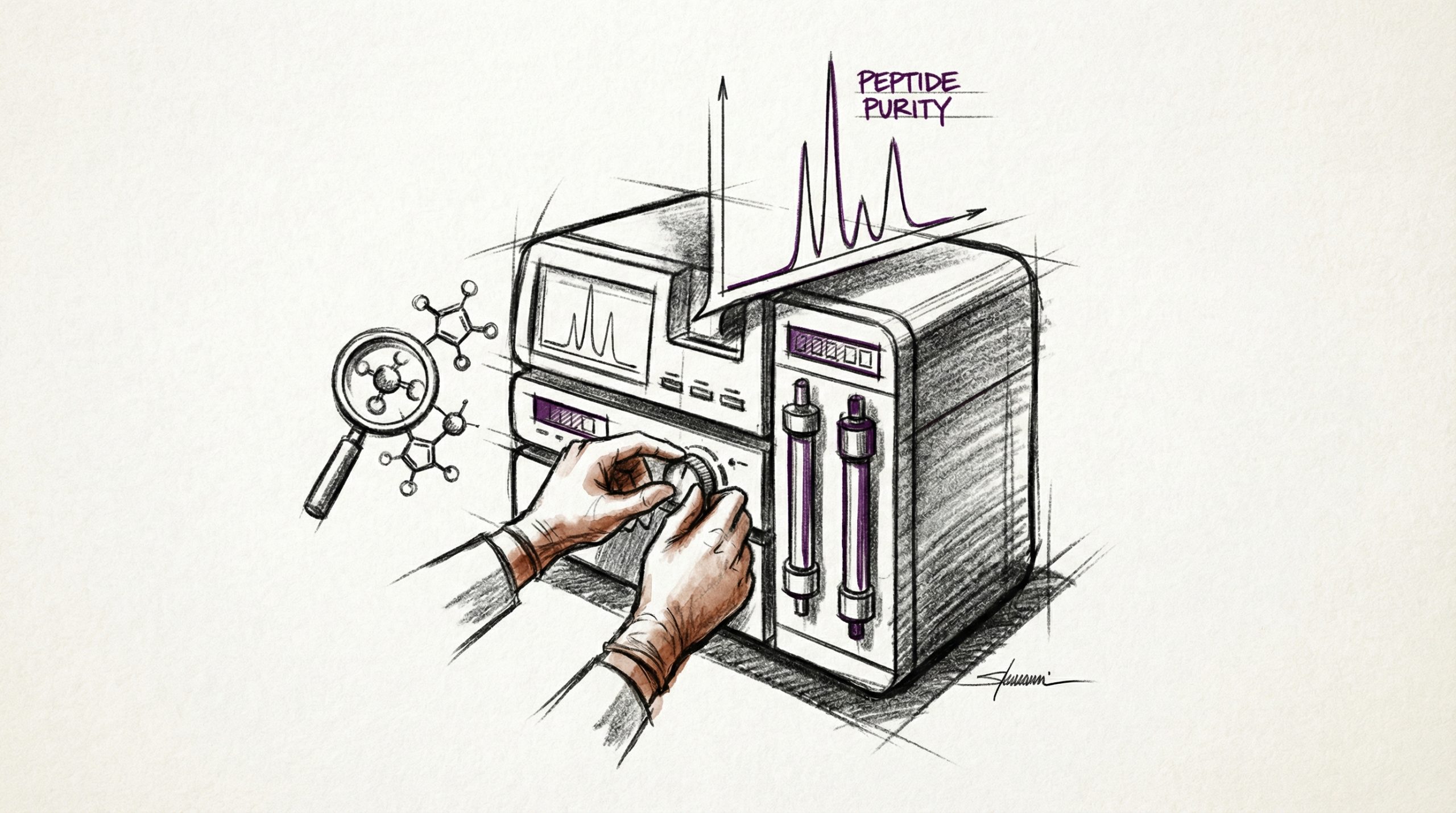
The gold standard for peptide purity measurement is high-performance liquid chromatography (HPLC), specifically reversed-phase HPLC (RP-HPLC). In this technique, the peptide sample is dissolved and injected into a chromatographic column. The column separates molecules based on their hydrophobicity — their tendency to interact with the non-polar stationary phase. The target peptide and its impurities elute at different times, producing peaks on a chromatogram. The purity percentage is calculated by dividing the area under the target peak by the total area of all peaks, multiplied by 100.
A well-synthesized research peptide at ≥98% purity produces a chromatogram with one dominant peak (the target compound) and minimal baseline noise. The column conditions (mobile phase gradient, flow rate, temperature) are standardized to ensure consistent results across laboratories. Most COAs include the actual chromatogram image, allowing experienced researchers to assess the quality of the separation and identify any unusual peak shapes that might indicate co-eluting impurities not captured in the simple percentage calculation.
What Does Mass Spectrometry Verify?
While HPLC measures how pure a sample is, mass spectrometry (MS) confirms what the sample actually is. MS determines the molecular weight of the peptide by ionizing the molecules and measuring their mass-to-charge ratio. The measured molecular weight is compared to the theoretical molecular weight calculated from the known amino acid sequence. A match (typically within 1-2 Da) confirms the peptide identity — that the compound in the vial is the correct molecule, not a different peptide or a degradation product with coincidentally similar HPLC retention time.
Common MS techniques used in peptide analysis include electrospray ionization (ESI-MS) and matrix-assisted laser desorption/ionization time-of-flight (MALDI-TOF) MS. ESI-MS produces multiply charged ions, showing a characteristic “charge envelope” pattern. MALDI-TOF produces primarily singly charged ions, giving a cleaner spectrum but requiring matrix preparation. Both methods are accepted in COA documentation. The MS spectrum should show a clear molecular ion peak at the expected mass, with minimal fragmentation or adduct peaks (PubMed: 20235100).
How Should Researchers Read a Certificate of Analysis?
A credible COA should contain several essential elements. First, the batch or lot number — this links the specific vial to the specific analytical run. Without a batch number, the COA cannot be verified against a specific production lot. Second, the HPLC purity percentage with the chromatogram image. The chromatogram should show a single dominant peak with a clean baseline, and the listed percentage should match what the chromatogram visually represents. Third, the mass spectrometry data showing the observed molecular weight and the expected molecular weight, with the difference (typically <2 Da). Fourth, identification of the testing laboratory — is it the manufacturer's in-house lab, or an independent third-party laboratory?
Red flags in COA evaluation include: COAs without batch numbers (potentially generic or fabricated), COAs showing only a purity percentage without the supporting chromatogram, MS data with molecular weight discrepancies greater than 2-3 Da, and COAs from testing labs that cannot be independently verified. Some suppliers issue COAs from their own internal labs, which creates a conflict of interest — the same entity producing and testing the product. Third-party testing by an independent analytical laboratory eliminates this conflict and provides researchers with objective quality data.
What Is Third-Party Testing and Why Does It Matter?
Third-party testing means the analytical work is performed by a laboratory that is organizationally independent from the peptide manufacturer or supplier. The testing lab has no financial incentive to report favorable results, and its reputation depends on analytical accuracy. This independence is the same principle behind third-party auditing in financial reporting — separation of interests ensures objectivity.
In the research peptide market, third-party testing is not universal. Many suppliers rely on COAs from their manufacturing partners in China, India, or other production regions. These COAs may be legitimate, but researchers have no way to verify their authenticity or accuracy. Some suppliers have been documented selling peptides with COAs that do not match the actual vial contents. Third-party tested peptides from a supplier like Peptideware provide an additional layer of verification — the COA comes from a lab with no commercial relationship to the product’s sale. For researchers designing protocols where reproducibility is critical, this distinction can be the difference between reliable and questionable data.
What Are Common Peptide Impurities?
Peptide synthesis is an iterative chemical process where amino acids are added one at a time to a growing chain. Each coupling step has a yield less than 100%, which means a small percentage of chains fail to add the next amino acid at each step. This produces several categories of impurities:
Truncated sequences: Peptide chains that terminated early during synthesis. A 15-amino-acid peptide synthesized with 99% coupling efficiency per step still produces approximately 14% truncated sequences (0.99^15 = 0.86, meaning only 86% of chains reach full length). These are the most common impurities.
Deletion peptides: Full-length chains missing one or more internal amino acids. These can have molecular weights close to the target and may co-elute on HPLC, making them harder to detect than truncated sequences.
Oxidized variants: Peptides containing methionine, cysteine, or tryptophan residues are susceptible to oxidation during synthesis, cleavage, or storage. Oxidized peptides may have altered biological activity.
Residual solvents and salts: TFA (trifluoroacetic acid) from the cleavage step and acetonitrile from HPLC purification can remain in the final product if not adequately removed. TFA is typically present as a counterion salt. For sensitive cell-based assays, TFA content should be minimized or the peptide should be exchanged to an acetate or hydrochloride salt form.
How Does Purity Affect Research Reproducibility?
Reproducibility is a foundational requirement of valid research, and peptide purity is a significant variable that often goes unreported. When a published study reports results using “BPC-157” or “semaglutide,” the compound’s purity is rarely specified in the methods section. If two laboratories attempt to replicate the same protocol using peptides from different suppliers at different purities, they may obtain different results — not because the underlying biology differs, but because the effective compound concentration differs. This purity-driven variability contributes to the broader reproducibility challenges documented across preclinical research (PubMed: 22460880).
Best practices for maximizing reproducibility include: specifying the peptide supplier and purity in all published methods, using the same supplier and batch throughout a study when possible, verifying COAs against actual vial contents periodically, and storing peptides under recommended conditions to prevent degradation over the course of a study. Researchers can find verified-purity peptides with published COAs for compounds like BPC-157, semaglutide, and TB-500 on the Peptideware product pages.
What Should Researchers Look for in a Peptide Supplier?
When evaluating peptide suppliers for research procurement, researchers should prioritize five criteria: (1) third-party analytical testing with COAs from identified independent laboratories, (2) batch-specific COAs published on product pages before purchase, (3) both HPLC and mass spectrometry data on every COA, (4) transparent contact information and domestic operations, and (5) consistent product availability without extended backorder periods. Suppliers who meet all five criteria demonstrate a commitment to quality documentation that aligns with research integrity standards.
Peptideware meets these criteria by providing independent HPLC and MS testing for every batch, publishing COAs directly on product pages for review before purchase, operating from Ohio with same-day domestic shipping, and maintaining consistent inventory across its catalog. For researchers new to peptide procurement, our research guides at HowToMixPeptides.com provide additional context on evaluating suppliers and understanding quality metrics, including a reconstitution calculator for accurate dosage preparation.
Frequently Asked Questions
What purity level is considered research-grade?
Research-grade peptides are typically defined as ≥98% purity by HPLC analysis. Peptides below 95% purity are generally considered unsuitable for quantitative research due to the confounding effects of impurities on concentration calculations and biological assays.
What is the difference between HPLC and mass spectrometry?
HPLC measures how pure a sample is — the percentage of material that is the target compound. Mass spectrometry confirms what the sample is — verifying that the molecular weight matches the expected peptide sequence. Both methods are needed for complete quality verification.
Can I trust a COA from the manufacturer?
Manufacturer COAs are a starting point but create a conflict of interest — the same entity producing and testing the product. Third-party COAs from independent analytical laboratories provide objective verification with no financial incentive to report favorable results.
How do I verify a COA is legitimate?
Check for a batch number linking the COA to a specific production lot, a chromatogram image (not just a percentage), mass spectrometry data with expected and observed molecular weights, and identification of the testing laboratory. If the testing lab is named, you can independently verify its existence and capabilities.
What happens if I use low-purity peptides in research?
Low-purity peptides introduce confounding variables: truncated sequences with partial activity, oxidized variants that trigger unrelated pathways, and inaccurate effective concentrations. Published studies have documented irreproducible results traced to reagent quality variations.
Does Peptideware provide third-party testing?
Yes. Every Peptideware batch undergoes independent HPLC and mass spectrometry analysis by third-party laboratories. COAs with batch numbers, chromatograms, and MS spectra are published on every product page for review before purchase.
How should peptides be stored to maintain purity?
Lyophilized peptides should be stored at -20 °C (-4 °F) for long-term storage. Reconstituted peptides should be stored at 2-8 °C (36-46 °F) and used within 21-28 days. Avoid repeated freeze-thaw cycles, temperatures above 25 °C, and direct UV light exposure.
For research purposes only. All products and information are provided for laboratory and research purposes only.


