


Last Updated: March 2026 | v1.0
Peptide reconstitution is the process of dissolving a lyophilized (freeze-dried) peptide powder into a sterile solution so it can be measured and administered in precise research dosages. Most research-grade peptides ship as a dry powder in sealed vials because lyophilization preserves molecular stability during transport and extends shelf life. Before any laboratory protocol can begin, researchers must reconstitute the peptide using bacteriostatic water (BAC water) — a sterile solvent containing 0.9% benzyl alcohol that inhibits microbial growth and keeps the solution viable for weeks. The reconstitution process itself is straightforward, but errors in technique, solvent volume, or storage conditions can degrade peptide integrity and compromise experimental results. This guide covers every step of the reconstitution workflow, from gathering supplies to calculating precise concentrations, so researchers can prepare peptides with confidence and reproducibility. All products and information are provided for laboratory and research purposes only.
Quick Facts: Peptide Reconstitution
- Solvent: Bacteriostatic water (BAC water) with 0.9% benzyl alcohol is the standard reconstitution solvent
- Temperature: Store reconstituted peptides at 2-8 °C (36-46 °F); never freeze reconstituted solutions
- Shelf life: Reconstituted peptides remain stable for approximately 21-28 days when refrigerated
- Technique: Always inject BAC water along the vial wall — never directly onto the lyophilized powder
- Sterility: Swab vial stoppers with 70% isopropyl alcohol before every needle insertion
Use the free reconstitution calculator for exact syringe units and concentration calculations, or browse the peptide reference library for compound-specific protocols.
What Supplies Are Needed for Peptide Reconstitution?
Before beginning any reconstitution protocol, researchers should gather all necessary materials in a clean workspace. The essential supplies include: the lyophilized peptide vial, bacteriostatic water (BAC water), sterile insulin syringes (typically 1 mL / 100-unit), and alcohol swab pads. A clean, flat work surface free from contaminants is critical. Some researchers also use nitrile gloves to prevent contamination from skin oils. For peptides requiring precise sub-milligram measurements, a syringe with 0.5-unit graduation markings provides better accuracy. Published laboratory protocols recommend using BAC water over sterile water for multi-use vials because the benzyl alcohol preservative maintains sterility across repeated withdrawals (PubMed: 18293860).
How Do You Reconstitute a Peptide Step by Step?
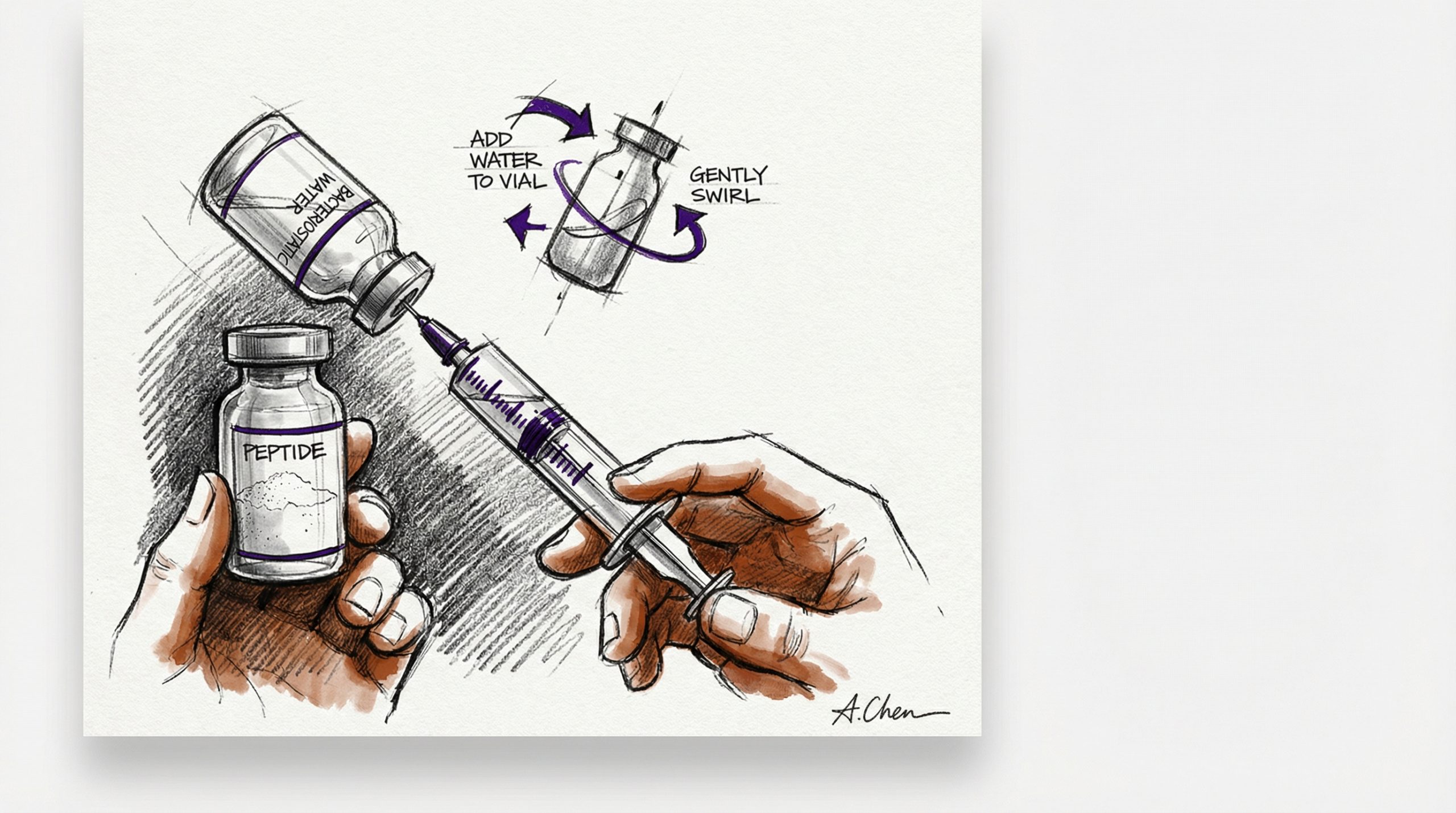
The reconstitution process follows a standard protocol used across peptide research laboratories. First, remove the peptide vial and BAC water from storage and allow both to reach room temperature — approximately 20-25 °C (68-77 °F) — for 5-10 minutes. Rapid temperature changes can denature peptide bonds. Next, wipe the rubber stopper of both the peptide vial and BAC water vial with a fresh alcohol swab. Draw the desired volume of BAC water into a sterile syringe. Insert the needle through the peptide vial’s stopper at a slight angle, and release the BAC water slowly along the inside wall of the vial. This prevents the force of the stream from damaging the peptide structure. Allow the solution to sit undisturbed for 2-3 minutes. Then gently roll the vial between your palms to ensure complete dissolution. Never shake a reconstituted peptide vial — agitation creates foam and can break peptide bonds, reducing potency.
How Much Bacteriostatic Water Should Researchers Use?
The volume of BAC water determines the concentration of the final solution, which directly affects how many syringe units equal a specific research dosage. There is no single “correct” volume — researchers choose a ratio based on the peptide mass and their desired per-unit concentration. Common reconstitution volumes are 1 mL, 2 mL, and 3 mL. For example, reconstituting a 10 mg peptide vial with 2 mL of BAC water yields a concentration of 5 mg/mL (5,000 mcg/mL). At this concentration, each unit on a 100-unit insulin syringe equals 50 mcg. For a research dosage of 500 mcg, a researcher would draw 10 units. The reconstitution calculator at HowToMixPeptides.com automates this math — input the vial size, BAC water volume, and desired dosage to get exact syringe units instantly.
What Are Common Reconstitution Mistakes to Avoid?
The most frequent error in peptide reconstitution is spraying BAC water directly onto the lyophilized cake. This concentrated force can physically fragment peptide chains before they dissolve, reducing the effective concentration of the solution. The second most common mistake is shaking the vial after adding solvent. Vigorous agitation introduces air bubbles and generates shear forces that denature proteins — preclinical research indicates that gentle swirling preserves over 95% of peptide integrity compared to approximately 80% with aggressive mixing (PubMed: 23532547). Other errors include using non-sterile water, reusing syringes between vials (introducing cross-contamination), failing to refrigerate the reconstituted solution, and drawing from the vial without first swabbing the stopper with alcohol. Each of these compromises either the chemical stability or the sterility of the research preparation.
How Should Reconstituted Peptides Be Stored?
After reconstitution, peptides must be stored at 2-8 °C (36-46 °F) — a standard laboratory refrigerator. Reconstituted peptide solutions remain stable for approximately 21-28 days under proper refrigeration. Exposure to temperatures above 25 °C (77 °F), direct sunlight, or UV light accelerates degradation. Researchers should never freeze a reconstituted peptide solution — ice crystal formation ruptures peptide bonds and destroys the molecule. Unreconstituted (lyophilized) peptides, by contrast, can be stored frozen at -20 °C (-4 °F) for extended periods without degradation. For best results, label each vial with the reconstitution date, peptide name, concentration, and BAC water volume used. This documentation ensures accurate dosing throughout the vial’s usable life. For detailed storage guidelines and protocol references, visit the research guides library on HowToMixPeptides.com.
What Peptides Are Commonly Reconstituted for Research?
Researchers across multiple disciplines regularly reconstitute peptides for laboratory study. Among the most widely studied are BPC-157 (a 15-amino-acid peptide being studied for tissue repair mechanisms), TB-500 (a synthetic fragment of thymosin beta-4 investigated in wound healing models), and semaglutide (a GLP-1 receptor agonist studied in metabolic research). Each peptide follows the same fundamental reconstitution protocol described above, though BAC water volumes and resulting concentrations vary by vial size. Researchers typically use 2 mL of BAC water for 10 mg vials and 3 mL for larger vials such as 30 mg or 50 mg presentations. Peptideware provides pharmaceutical-grade BAC water and research peptides with third-party purity verification for every batch.
Frequently Asked Questions
Can I use sterile water instead of bacteriostatic water?
Sterile water lacks a preservative, so the reconstituted solution must be used within 24 hours. Bacteriostatic water contains 0.9% benzyl alcohol, which inhibits bacterial growth and extends usable life to 21-28 days under refrigeration. For multi-use research vials, BAC water is the standard.
How long do reconstituted peptides last?
When stored at 2-8 °C (36-46 °F), reconstituted peptides prepared with BAC water typically remain stable for 21-28 days. Unreconstituted lyophilized peptides stored at -20 °C (-4 °F) can remain viable for 12-24 months.
What happens if I shake the vial instead of rolling it?
Shaking creates foam and introduces mechanical stress that can break peptide bonds. Published studies suggest gentle swirling preserves over 95% peptide integrity, while vigorous shaking may reduce potency by up to 20%.
Do I need to refrigerate BAC water before use?
Unopened BAC water can be stored at room temperature. Once opened or after first needle puncture, store it at 2-8 °C (36-46 °F) and use within 28 days. Allow it to reach room temperature before reconstitution.
How do I calculate syringe units from concentration?
Divide the desired research dosage (in mcg) by the concentration per unit. For a 10 mg vial reconstituted with 2 mL BAC water: concentration = 5,000 mcg/mL, each syringe unit = 50 mcg. For 500 mcg, draw 10 units. Use the peptide calculator for automatic conversions.
Can I reconstitute a peptide more than once?
No. Reconstitution is a one-time process per vial. Once the lyophilized powder is dissolved, it cannot be re-lyophilized in a standard laboratory setting. Prepare only the amount needed and store the solution properly.
Why does my peptide look cloudy after adding BAC water?
Minor cloudiness immediately after adding solvent is normal and usually clears within 2-5 minutes as the peptide fully dissolves. If the solution remains cloudy after 10 minutes of gentle swirling, the peptide may have degraded or the solvent may be contaminated. Do not use a persistently cloudy solution.
For research purposes only. All products and information are provided for laboratory and research purposes only.


