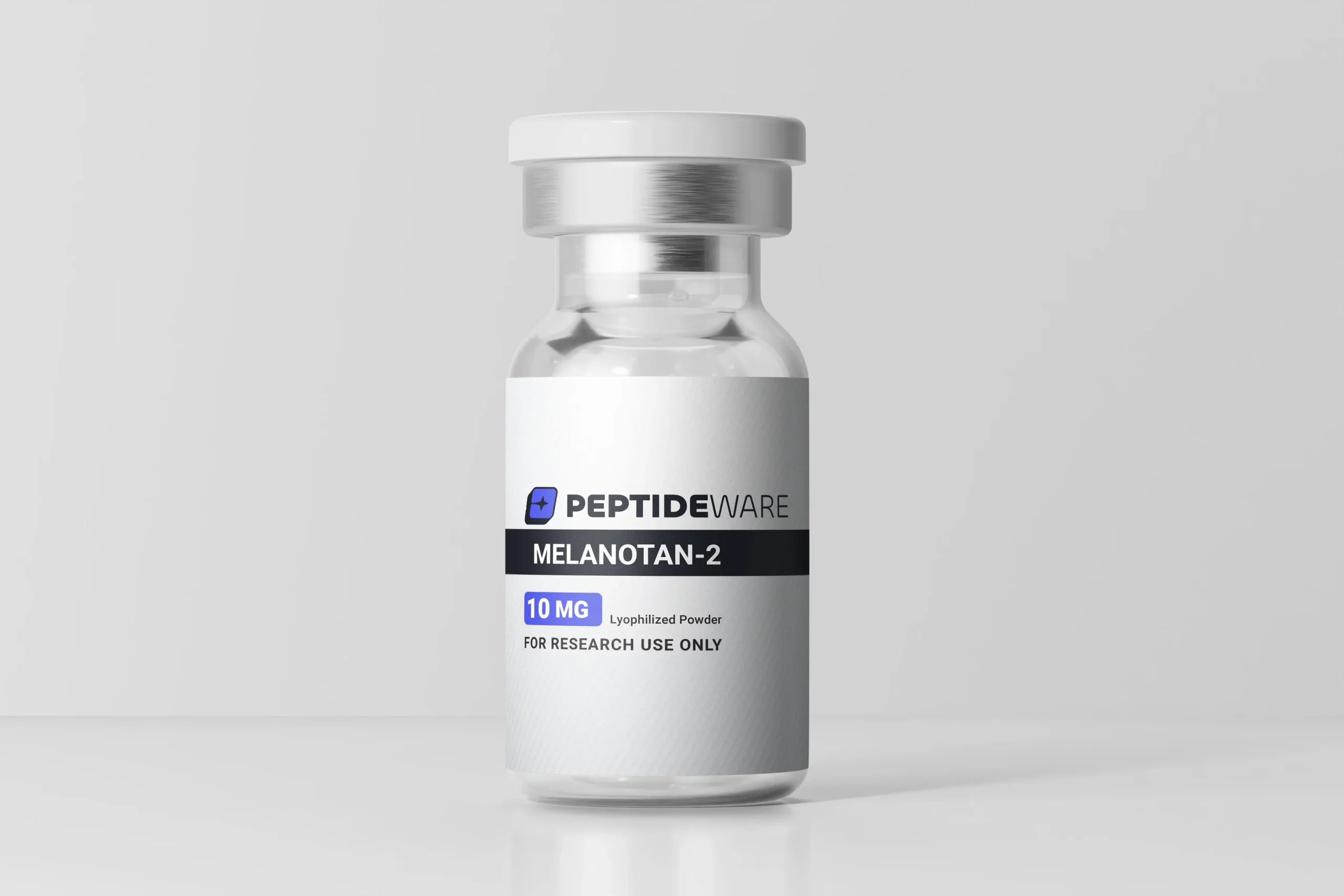


Description
Multifaceted Receptor Agonism
The primary research value of Melanotan II lies in its non-selective agonist activity. It exhibits high affinity for multiple subtypes of the melanocortin receptor family, allowing for a diverse range of physiological investigations:
-
MC1R (Melanogenesis): MT-2 is chemically designed to bind to the Melanocortin-1 Receptor (MC1R). Research studies focus on its ability to upregulate the synthesis of eumelanin (photoprotective pigment) within melanocytes, independent of UV radiation exposure.
-
MC3R & MC4R (Metabolic & CNS Signaling): By crossing the blood-brain barrier in animal models, MT-2 interacts with MC3 and MC4 receptors in the hypothalamus.
-
Energy Balance: These receptors are key regulators of energy homeostasis. Studies investigate how MC4R activation influences appetite suppression and metabolic rate.
-
Sexual Function: Activation of central MC3/MC4 receptors is studied for its role in the neurogenic pathways of sexual arousal and erectile function, mediating signals through the central nervous system rather than vascular mechanisms alone.
-
This research peptide undergoes rigorous quality control and stability testing to ensure maximum integrity for scientific applications. Each batch is manufactured under strict laboratory conditions and verified through independent laboratory analysis.
⚠️ FOR RESEARCH PURPOSES ONLY
This research peptide undergoes rigorous quality control and stability testing to ensure maximum integrity for scientific applications. Each batch is manufactured under strict laboratory conditions and verified through independent laboratory analysis.
For research purposes only. Not for human consumption.
Technical Specifications
-
Chemical Name: Melanotan II (MT-II)
-
Sequence: Ac-Nle-Asp-His-D-Phe-Arg-Trp-Lys-NH2 (Cyclic)
-
CAS Number: 121062-08-6
-
Formula: C₅₀H₆₉N₁₅O₉
-
Molar Mass: 1024.2 g/mol
-
Purity: ≥99% (HPLC Verified)
-
Form: Lyophilized White Powder
⚠️ Research Note: Photostability & Handling
UV Sensitivity Warning: Melanotan II is sensitive to ultraviolet (UV) light degradation, particularly after reconstitution in solution.
-
Storage: Reconstituted vials should be stored in amber glass containers or kept in a light-proof box within the refrigerator.
-
Handling: Avoid leaving the vial exposed to direct sunlight or intense laboratory lighting for extended periods, as this may compromise the peptide’s structural integrity and binding affinity.