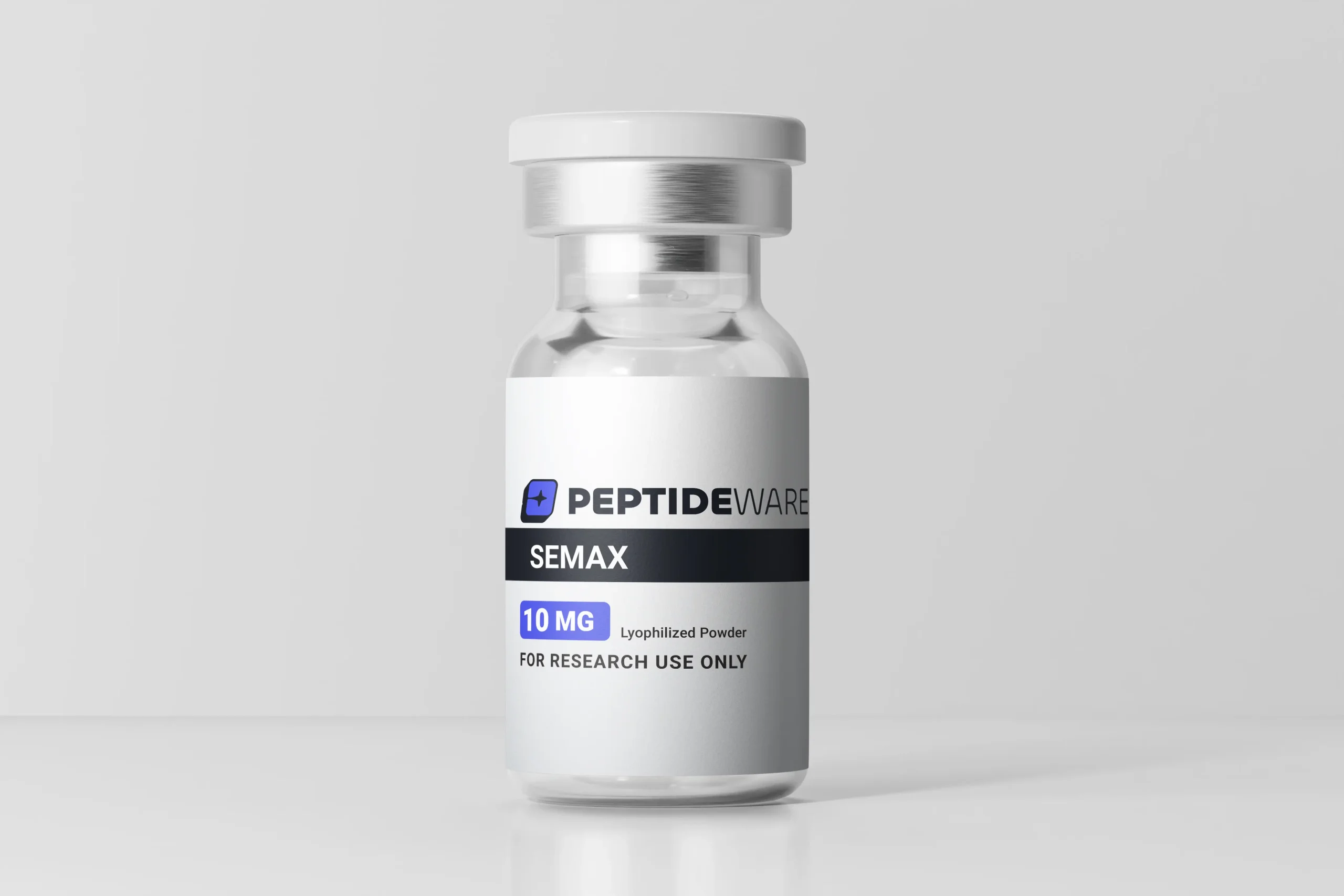


Description
What Is Semax?
Semax is a synthetic heptapeptide analog of the ACTH fragment 4-10. It retains neurogenic and cognitive-enhancing properties without adrenal stimulation. Research focuses on BDNF upregulation, neuroprotection, and cognitive performance. Approved as a nootropic in Russia. HPLC-verified at 99%+ purity with publicly available COA.
Why Researchers Choose Semax
- ACTH Fragment 4-10 Analog — Derived from the biologically active core of adrenocorticotropic hormone, retaining neurotrophic properties while eliminating hormonal activity.
- Neurotrophic Factor Modulation (BDNF/NGF) — Published studies suggest Semax rapidly upregulates Brain-Derived Neurotrophic Factor and Nerve Growth Factor expression in key brain regions.
- No Hormonal Activity Despite ACTH Origin — Preclinical research indicates Semax does not stimulate the adrenal cortex or alter cortisol levels, isolating the nootropic properties from the parent hormone.
- Verified Purity: ≥99% (HPLC) — Every batch undergoes independent third-party laboratory verification to ensure maximum integrity for research applications.
- 10 mg Format for Cognitive Research — Higher-quantity vials designed for extended research protocols investigating neuroplasticity and neurotransmitter dynamics.
Frequently Asked Questions
What is Semax?
Semax is a synthetic heptapeptide analog of the ACTH(4-10) fragment, originally developed at the Institute of Molecular Genetics of the Russian Academy of Sciences. It is one of the most studied nootropic peptides in preclinical literature, with research focusing on its ability to modulate neurotrophic factor expression, neurotransmitter turnover, and neuroprotective pathways without producing hormonal or endocrine effects.
How do I reconstitute Semax for laboratory use?
Add 2 mL of bacteriostatic water to the 10 mg vial to achieve a working concentration of 5 mg/mL. Direct the stream of water down the inside wall of the vial rather than directly onto the lyophilized cake. Swirl gently — do not shake. Allow up to 5 minutes for complete dissolution before use in research protocols.
What purity standard does this product meet?
Every batch is verified at ≥99% purity via high-performance liquid chromatography (HPLC) through independent third-party laboratory analysis.
How should Semax be stored?
Store the lyophilized powder at -20°C or below for long-term stability (up to 24 months). Once reconstituted, store at 2-8°C and use within 4 weeks. Protect from light and avoid repeated freeze-thaw cycles to maintain structural integrity.
What is the difference between Semax and Selank?
Semax and Selank are complementary but mechanistically distinct peptides. Semax is primarily studied for its nootropic and neurotrophic properties — it upregulates BDNF and NGF, modulates dopamine and serotonin turnover, and is investigated in neuroplasticity research. Selank, a tuftsin-derived peptide, is primarily studied for its anxiolytic and immunomodulatory properties through GABA modulation and enkephalin stabilization. Researchers frequently study both in complementary protocols.
What does published research say about Semax?
Preclinical research indicates Semax rapidly increases BDNF and NGF expression in the hippocampus and forebrain, enhances dopamine and serotonin turnover in the CNS, and modulates functional connectivity between brain networks in imaging studies. Published studies suggest neuroprotective effects in ischemia models, and research continues into its influence on synaptic plasticity and long-term memory formation.
Can Semax be used in combination research protocols?
Published studies have examined Semax alongside other neuropeptides, including Selank. Researchers investigating complementary nootropic and anxiolytic pathways often design protocols incorporating multiple compounds targeting distinct neurotransmitter systems. Always consult peer-reviewed literature when designing multi-compound research protocols.
Further Reading
New to peptide research? Visit our Peptide Reconstitution 101 guide for step-by-step instructions on proper handling, storage, and reconstitution techniques.
Mechanism: BDNF Upregulation & Neuroprotection
Semax is unique in its ability to modulate the central nervous system through gene expression and neurotrophic support:
-
BDNF & NGF Synthesis: Research demonstrates that Semax rapidly upregulates the expression of Brain-Derived Neurotrophic Factor (BDNF) and Nerve Growth Factor (NGF) in the hippocampus and forebrain. These proteins are critical for neuronal survival, synaptic plasticity, and long-term memory formation.
-
Default Mode Network (DMN): fMRI studies suggest Semax modulates the connection between the DMN and task-positive networks, potentially enhancing resting-state functional connectivity and attention switching.
-
Neurotransmitter Turnover: The peptide is observed to increase the turnover of dopamine and serotonin, improving neurotransmission efficiency without the neurotoxicity associated with amphetamine-class compounds.
This research peptide undergoes rigorous quality control and stability testing to ensure maximum integrity for scientific applications. Each batch is manufactured under strict laboratory conditions and verified through independent laboratory analysis.
⚠️ FOR RESEARCH PURPOSES ONLY
This product is strictly for in-vitro laboratory research, analysis, and development. It is not intended for human consumption, injection, or therapeutic use. Semax is not a drug.
Technical Specifications
-
Sequence: Met-Glu-His-Phe-Pro-Gly-Pro
-
Identity: Synthetic ACTH (4-10) Analogue
-
Formula: {37}H_{51}N_{9}O_{10}S$
-
Molar Mass: ~813.9 g/mol
-
CAS Number: 80714-61-0
-
Purity: ≥99% (HPLC Verified)
-
Form: Lyophilized White Powder
Storage & Handling
Peptides require careful storage to maintain their integrity and research effectiveness. Lyophilized peptides should be stored in a cold, dry, dark environment to prevent degradation. For short-term use within 4 weeks, storage at 4°C is sufficient, while long-term storage requires temperatures below -20°C or -80°C for extended periods up to 2 years. Always protect peptides from light exposure and avoid repeated freeze-thaw cycles, which can compromise structural integrity and research results.