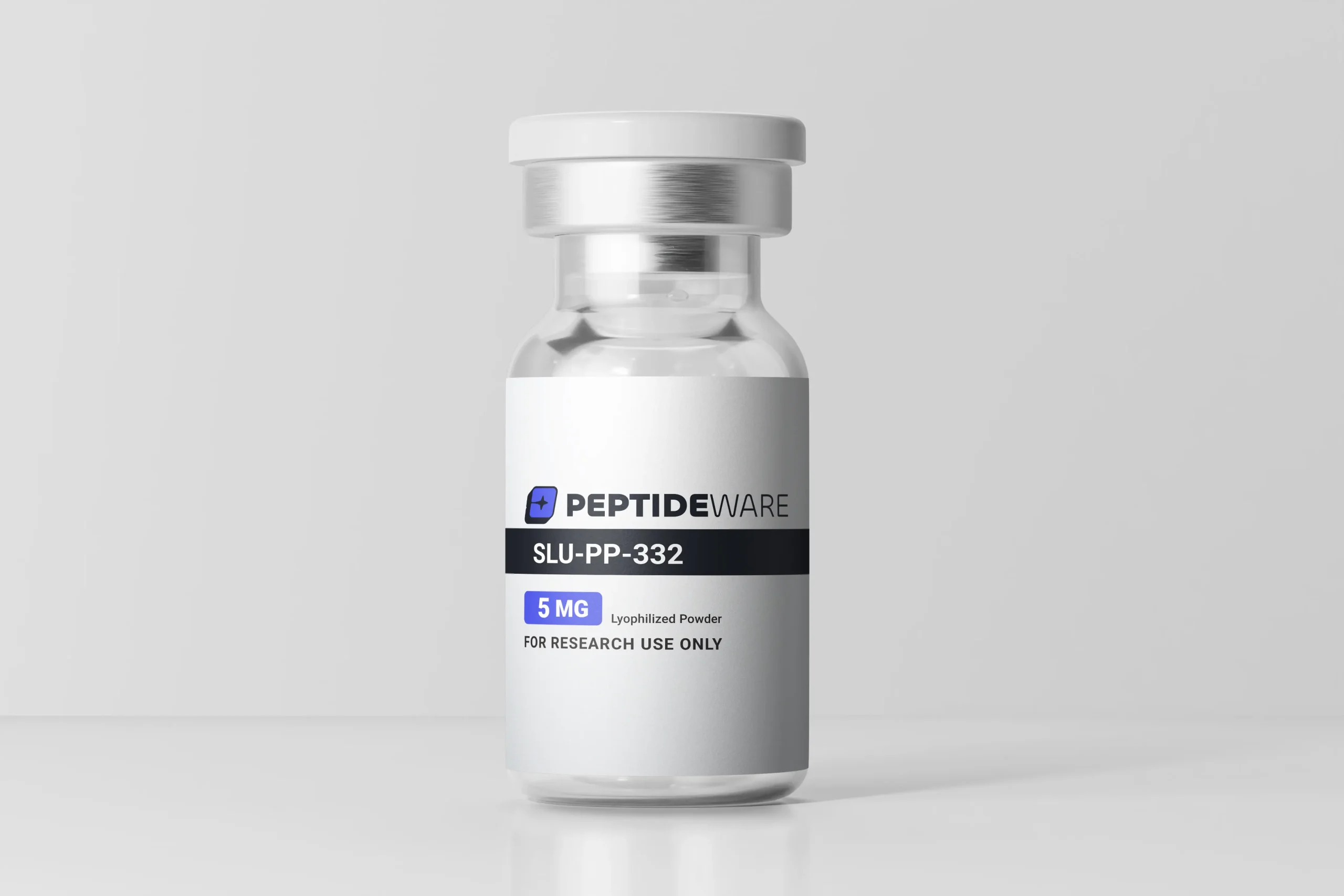


Description
Mechanism: Estrogen-Related Receptor (ERR) Agonism
SLU-PP-332 is distinguished by its high selectivity for ERR$\alpha$ and ERR$\gamma$ (Estrogen-Related Receptor Alpha and Gamma). Importantly, it does not bind to the classical Estrogen Receptor (ER), avoiding hormonal side effects.
-
Mitochondrial Biogenesis: By activating ERR, SLU-PP-332 drives the transcription of genes involved in the Electron Transport Chain (ETC) and the Krebs cycle.
-
Fiber Type Switching: Research demonstrates that administration can induce a phenotypic shift in skeletal muscle, increasing the proportion of Type I (Oxidative/Slow-Twitch) fibers. These fibers are dense in mitochondria and resistant to fatigue.
-
Fatty Acid Oxidation: The compound promotes the utilization of fatty acids as a primary fuel source, effectively increasing whole-body energy expenditure without altering caloric intake or appetite.
This research peptide undergoes rigorous quality control and stability testing to ensure maximum integrity for scientific applications. Each batch is manufactured under strict laboratory conditions and verified through independent laboratory analysis.
⚠️ FOR RESEARCH PURPOSES ONLY
This product is strictly for in-vitro laboratory research, analysis, and development. It is not intended for human consumption, injection, or therapeutic use. SLU-PP-332 is not a drug.
Technical Specifications
-
Chemical Class: Synthetic ERR Agonist (Benzimidazole Derivative)
-
Target: Estrogen-Related Receptor (ERR$\alpha$ / ERR$\gamma$)
-
Formula: $C_{24}H_{26}N_{2}O_{4}$
-
Molar Mass: ~406.5 g/mol
-
Purity: ≥99% (HPLC Verified)
-
Form: Lyophilized White Powder
-
Solubility: Soluble in DMSO; requires careful reconstitution protocols for aqueous solutions.
Storage & Handling
Peptides require careful storage to maintain their integrity and research effectiveness. Lyophilized peptides should be stored in a cold, dry, dark environment to prevent degradation. For short-term use within 4 weeks, storage at 4°C is sufficient, while long-term storage requires temperatures below -20°C or -80°C for extended periods up to 2 years. Always protect peptides from light exposure and avoid repeated freeze-thaw cycles, which can compromise structural integrity and research results.