


Last Updated: April 14, 2026
SS-31, also known as elamipretide or Bendavia, is a small tetrapeptide developed at Cornell by Hazel Szeto and Peter Schiller as part of the Szeto-Schiller peptide series. Its four-residue sequence — D-Arg-2′,6′-dimethylTyr-Lys-Phe-NH2 — is engineered around an alternating aromatic/basic motif that concentrates the peptide thousands-fold at the inner mitochondrial membrane, where it associates non-covalently with cardiolipin. Preclinical research indicates that this localisation preserves cristae architecture, supports electron-transport-chain efficiency, and attenuates reactive oxygen species generation under ischemic, toxic, and aged conditions. Unlike many biologically active peptides that signal through extracellular receptors, SS-31 functions structurally inside the organelle, interacting with the lipid-headgroup environment rather than a conventional binding pocket. This SS-31 research guide summarises the peptide’s chemistry, its cardiolipin interaction, the preclinical literature on ischemia-reperfusion and aging, and the laboratory handling practices that apply to the 10 mg research vial. For broader catalogue context see our longevity peptides guide.
Quick Facts
- Peptide class: Szeto-Schiller aromatic-basic tetrapeptide
- Sequence: D-Arg-Dmt-Lys-Phe-NH2 (Dmt = 2′,6′-dimethyltyrosine)
- Alternate names: Elamipretide, Bendavia, MTP-131
- Molecular weight: ~639.8 g/mol
- Research format: 10 mg lyophilised powder per vial
- Mitochondrial target: Cardiolipin on inner mitochondrial membrane
- Primary research domains: ischemia-reperfusion models, heart failure, aging mitochondria, mitochondrial myopathies
What is SS-31 and how was it designed?
SS-31 is the fourth member of the Szeto-Schiller peptide series, developed in the Szeto laboratory at Weill Cornell Medical College. The design intent was to create a small water-soluble peptide that would cross the outer mitochondrial membrane, concentrate at the inner membrane, and interact with cardiolipin — the tetra-acyl phospholipid unique to this organelle. The alternating aromatic (dimethyltyrosine, phenylalanine) and basic (arginine, lysine) residues generate a 3+ net positive charge at physiological pH alongside a hydrophobic face, producing the “aromatic-cationic” motif that drives inner-membrane partitioning. Szeto’s 2006 review in the AAPS Journal (PMID 17025272) documented how cell-permeant SS peptides reach mitochondria at concentrations 1000-5000 times greater than cytosolic levels within minutes of exposure, a property that underlies every subsequent research application.
How does SS-31 localise to the inner mitochondrial membrane?
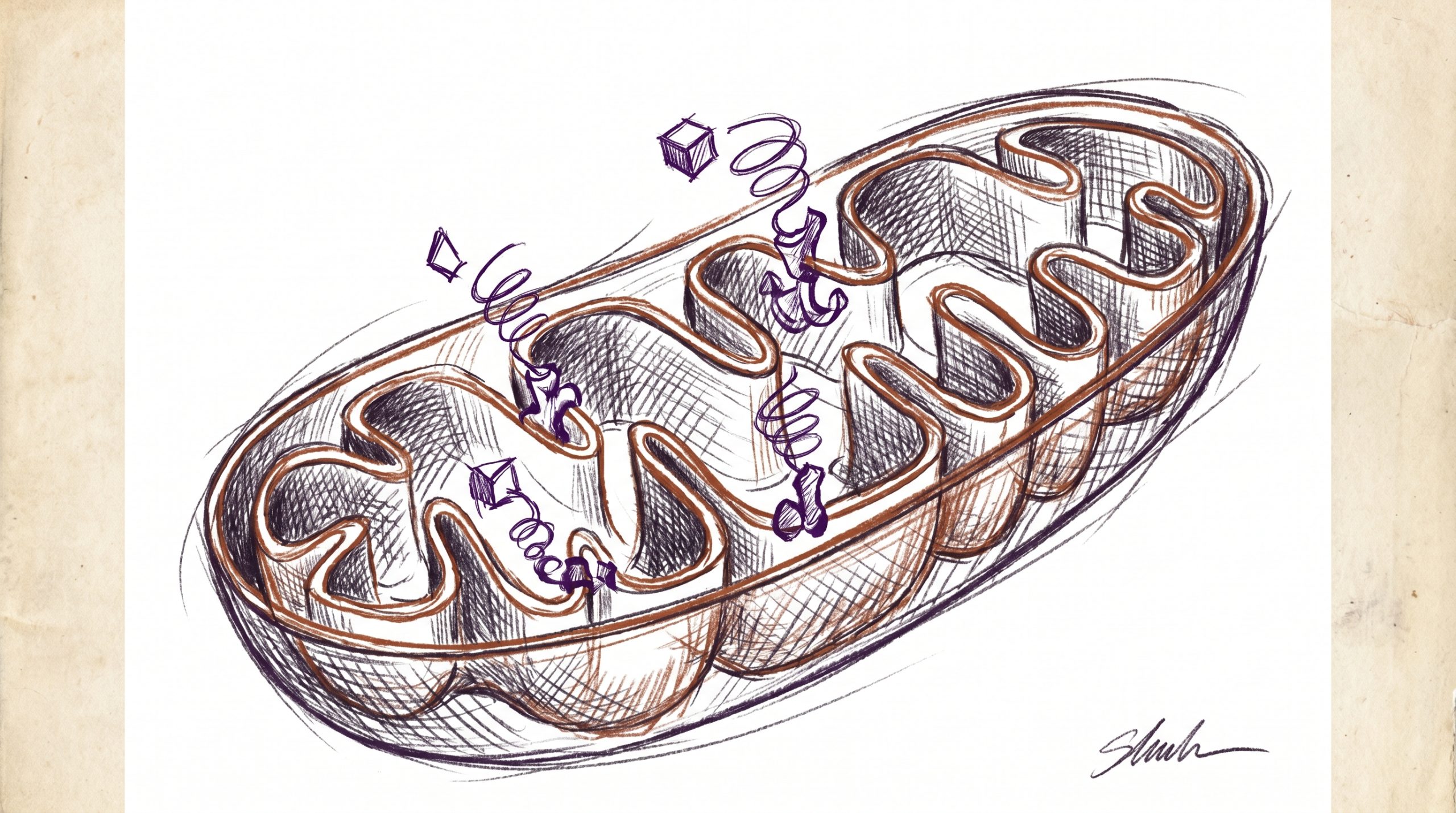
Inner-membrane concentration of SS-31 does not depend on the membrane potential, distinguishing the peptide from conventional mitochondrial-targeted compounds such as MitoQ that rely on triphenylphosphonium cations to ride the electrochemical gradient. Preclinical research indicates that SS-31 associates directly with cardiolipin through electrostatic contacts between the peptide’s basic residues and the phospholipid’s phosphate headgroups, reinforced by aromatic-acyl-chain interactions. A 2011 Journal of Biological Chemistry paper by Birk et al. confirmed the cardiolipin-binding model using liposome and isolated-mitochondria assays. Because cardiolipin organises super-complex assembly of the electron transport chain, SS-31’s association with this lipid has structural consequences for respiratory efficiency that are distinct from classical free-radical scavenging.
Why is cardiolipin the critical binding partner?
Cardiolipin accounts for roughly 15-20% of inner-membrane phospholipid content and organises the supramolecular architecture of Complexes I, III, and IV into respiratory super-complexes. The phospholipid is also uniquely susceptible to peroxidation because of its polyunsaturated acyl chains and its proximity to the ROS-generating complexes. Published studies suggest that cardiolipin peroxidation under ischemic, toxic, or aged conditions destabilises super-complex assembly and releases cytochrome c, initiating apoptosis. SS-31 binding appears to protect cardiolipin from peroxidation and preserve cristae curvature, as documented by Birk et al. (2013) in Journal of the American Society of Nephrology. This structural protection is the mechanistic hypothesis that links SS-31 to improved respiratory efficiency across the ischemia-reperfusion, aging, and mitochondrial-myopathy literature.
What does ischemia-reperfusion research indicate about SS-31?
Ischemia-reperfusion injury — the paradoxical tissue damage that follows restoration of blood flow — is driven in large part by a burst of mitochondrial ROS at reperfusion onset. Kloner and colleagues reported in Journal of the American Heart Association (PMID 23316303) that SS-31 administration in preclinical rodent and porcine cardiac models reduced infarct size when delivered before reperfusion. Subsequent studies extended the observation to renal ischemia-reperfusion models (Birk 2013) and to neuronal models. The clinical-stage compound elamipretide — the same molecule under a pharmaceutical trade name — progressed through Phase II trials in reperfusion injury, primary mitochondrial myopathy, and Barth syndrome. Laboratory research on the tetrapeptide remains active across cardiology, nephrology, and neuroscience because the cardiolipin-protection hypothesis explains why a single compound shows benefit across multiple ischemic organ systems in preclinical work.
How does SS-31 behave in aged-mitochondria research?
Aged mitochondria show declining respiratory capacity, elevated ROS leakage, cardiolipin peroxidation, and disorganised cristae — a phenotype that parallels the acute damage seen in ischemia-reperfusion. Siegel and colleagues published in Aging Cell (PMID 23469713) that SS-31 administration in aged mice restored skeletal-muscle mitochondrial ATP production to levels comparable with young controls. A separate Circulation Research study by Dai et al. (2014) reported that cardiac diastolic function improved in aged mice following SS-31 exposure, alongside reduced cardiolipin peroxidation markers. These findings anchor the tetrapeptide in longevity research frameworks alongside NAD+ precursors, MOTS-c, and Humanin. For comparative discussion see our NAD+ vs SS-31 research comparison.
What is the 10mg research format and how is it supplied?
The SS-31 10mg research vial ships as lyophilised powder, third-party verified for identity and purity, with a certificate of analysis. A 10 mg mass corresponds to roughly 15.6 micromoles of peptide, sufficient for multi-plate cell-culture titrations in the micromolar working range typical of published studies, for isolated-mitochondria experiments, or for small-animal preclinical protocols over several weeks. Lyophilised powder protects the peptide bonds during transit and storage; the dimethyltyrosine residue is stable but the peptide as a whole is best kept dry until the day of reconstitution. Researchers running parallel experiments with NAD+ or other mitochondrial compounds frequently standardise reconstitution vehicle and storage practices so that data are comparable across arms of a single protocol.
How is SS-31 reconstituted and stored for laboratory use?
SS-31 dissolves readily in bacteriostatic water, sterile water for injection, or phosphate-buffered saline at neutral pH. A common laboratory working stock is 1 mM, prepared by reconstituting the 10 mg vial in roughly 15.6 mL of vehicle, or a more concentrated 5 mM stock in 3.1 mL for dilution-series experiments. Filter-sterilise reconstituted solutions through a 0.22 µm low-protein-binding membrane. Store reconstituted stock at 2-8°C for short-term use (up to 14 days) or flash-freeze in single-use aliquots at -20°C or -80°C for longer retention. Avoid repeated freeze-thaw cycles, which can degrade the C-terminal amide and the dimethyltyrosine residue. Lyophilised powder stored desiccated at -20°C retains activity for years. All handling steps are performed for laboratory and research purposes only.
Which cell-culture and preclinical models dominate SS-31 research?
H9c2 cardiomyoblasts, primary adult cardiomyocytes, HK-2 renal tubular cells, and primary cortical neurons appear repeatedly across the SS-31 literature because each is sensitive to mitochondrial ROS and cardiolipin peroxidation. Isolated cardiac and renal mitochondria are standard for mechanistic studies of oxygen consumption, membrane potential, and calcium retention capacity. Preclinical rodent and porcine models of myocardial ischemia-reperfusion, renal ischemia-reperfusion, age-related cardiac dysfunction, and mitochondrial myopathy have all been published. Investigators pairing SS-31 with NAD+ research protocols examine whether direct cardiolipin protection (SS-31) acts additively or synergistically with NAD+/sirtuin-mediated mitochondrial biogenesis — a comparison framework detailed in our NAD+ vs SS-31 research comparison for laboratory planning.
How does SS-31 compare with antioxidant-only compounds?
Classical antioxidants such as N-acetylcysteine and vitamin E scavenge free radicals non-specifically across cellular compartments. Mitochondrial-targeted antioxidants such as MitoQ concentrate at the inner membrane via the triphenylphosphonium cation and accept electrons from respiratory intermediates. SS-31 differs mechanistically: published studies suggest that its primary action is stabilisation of cardiolipin and cristae architecture rather than radical scavenging per se. A 2013 FEBS Letters review by Szeto articulated this distinction, framing SS-31 as a structural agent that improves electron-transport-chain coupling efficiency and reduces the conditions under which ROS form. Researchers designing comparison experiments typically include a MitoQ or SkQ1 arm alongside SS-31 to dissect charge-driven partitioning from the cardiolipin-mediated structural mechanism hypothesised for the Szeto-Schiller class.
Ready to source SS-31 for your research protocol?
Investigators purchasing for laboratory use can acquire the SS-31 10mg research vial directly from Peptideware. Each lot is lyophilised, third-party verified for identity and purity, and shipped with a certificate of analysis. For comparative work with NAD+ see our NAD+ vs SS-31 research comparison, and the catalogue-wide longevity peptides guide.
Frequently Asked Questions
What is SS-31 and how does it differ from other peptides?
SS-31 is a four-residue tetrapeptide (D-Arg-Dmt-Lys-Phe-NH2) developed by Hazel Szeto and Peter Schiller as part of the Szeto-Schiller class of mitochondrial-targeted peptides. Unlike receptor-agonist peptides such as GLP-1 analogues or growth-hormone secretagogues, SS-31 does not bind a cell-surface receptor. Instead, preclinical research indicates that it concentrates at the inner mitochondrial membrane through non-covalent association with cardiolipin, the phospholipid that organises respiratory super-complexes. Its mechanism is therefore structural rather than signalling-based, which explains the breadth of tissues where it has been studied — heart, kidney, brain, skeletal muscle — and why researchers classify it alongside NAD+ and MOTS-c in the broader category of mitochondrial-support compounds under investigation in laboratory protocols.
Why is SS-31 also called elamipretide or Bendavia?
SS-31 is the academic research-code name assigned in the Szeto laboratory for the 31st peptide in the Szeto-Schiller synthesis series. Elamipretide is the International Nonproprietary Name (INN) assigned for pharmaceutical development, and Bendavia was the original clinical trade name used by Stealth BioTherapeutics during early clinical-stage work, later replaced by elamipretide. MTP-131 is another code name that appears in some publications. All four names refer to the same molecule — the D-Arg-Dmt-Lys-Phe-NH2 tetrapeptide. Researchers reviewing the literature should search each synonym to capture the full publication record. The research-format product catalogued at Peptideware is supplied as SS-31 lyophilised powder for laboratory use only, not as the clinical-stage formulation.
Does SS-31 require a membrane potential to localise to mitochondria?
No. This is a notable distinction between SS-31 and triphenylphosphonium-conjugated compounds such as MitoQ. TPP-conjugated molecules accumulate in mitochondria because the positively charged TPP cation is attracted to the negative inner-membrane potential; depolarised or damaged mitochondria therefore accumulate less compound. Preclinical research indicates that SS-31 localises independently of membrane potential, associating with cardiolipin through electrostatic and aromatic interactions that persist even when the organelle is depolarised. This property is mechanistically important for ischemia-reperfusion research, where mitochondrial membrane potential collapses during ischemia; SS-31 can still reach its target in compromised organelles, while potential-dependent compounds lose localisation efficiency under precisely the conditions where protection is most needed in laboratory models.
What storage conditions preserve SS-31 activity?
Lyophilised SS-31 powder is stable for years at -20°C when protected from moisture in a sealed, desiccated container. Short-term transit at 2-8°C is acceptable. Once reconstituted in aqueous buffer, the peptide should be stored at 2-8°C for up to 14 days of working use or flash-frozen in single-use aliquots at -20°C or -80°C for longer retention. Avoid repeated freeze-thaw cycles, which can progressively degrade the C-terminal amide and the 2′,6′-dimethyltyrosine side chain. Filter-sterilise reconstituted solutions through a 0.22 µm low-protein-binding membrane to prevent peptide adsorption losses. Researchers running longitudinal experiments should verify peptide identity by mass spectrometry before committing long-stored stock to critical experimental arms in published laboratory protocols.
What concentration range does published SS-31 research use?
Published laboratory studies typically use SS-31 in the nanomolar-to-low-micromolar range for cell-culture work (commonly 1 nM to 1 µM) and isolated-mitochondria assays (100 nM to 10 µM). Preclinical rodent protocols have published dose ranges of 1-5 mg/kg in various delivery vehicles. Because SS-31 concentrates 1000-5000 times at the inner mitochondrial membrane relative to cytosol, effective intra-mitochondrial concentrations are much higher than the bulk incubation concentration would suggest. Researchers designing new protocols should consult the target-tissue literature for published effective ranges and titrate from there. The 10 mg research vial provides sufficient material for multi-plate dose-response experiments, paired time-course studies, or small-animal preclinical protocols over the course of a research programme.
Is SS-31 the same as the clinical drug elamipretide?
The molecular structure is identical — D-Arg-Dmt-Lys-Phe-NH2 tetrapeptide. The difference is regulatory and formulation context. Elamipretide refers to the pharmaceutical-grade preparation developed by Stealth BioTherapeutics that has progressed through clinical-stage evaluation in primary mitochondrial myopathy, Barth syndrome, and dry age-related macular degeneration under FDA and EMA oversight. SS-31 as catalogued at Peptideware is a laboratory research reagent supplied as lyophilised powder for in-vitro and preclinical experimental use only — not for human or animal consumption. Researchers citing SS-31 in publications should disclose the laboratory-research source when relevant, and should not conflate research-grade material with the formulated clinical product even though the underlying peptide sequence is the same in both contexts.
Can SS-31 research be combined with NAD+ research protocols?
Many laboratory groups design parallel or combination arms that pair SS-31 with NAD+ or NAD+ precursors. The rationale is mechanistic complementarity: SS-31 is hypothesised to preserve cardiolipin and cristae structure, while NAD+ supplies the obligate substrate for sirtuin-mediated mitochondrial biogenesis and quality control. Preclinical research has examined whether these interventions are additive, synergistic, or redundant in aged rodents and in isolated-mitochondria systems. Readouts typically include oxygen consumption rate (Seahorse respirometry), membrane potential (TMRM or JC-1), cardiolipin peroxidation markers, and sirtuin substrate acetylation. For a structured comparison framework designed for laboratory planning, see our dedicated NAD+ vs SS-31 research comparison, which summarises mechanistic differences, experimental endpoints, and published combination studies.
Research Disclaimer: All products are intended for laboratory and research purposes only. Not for human or animal consumption. These statements have not been evaluated by the FDA. The content above summarises preclinical and in-vitro research literature and does not constitute medical advice or recommendations.


